Today’s Contemplation: Collapse Cometh CCXLIV–
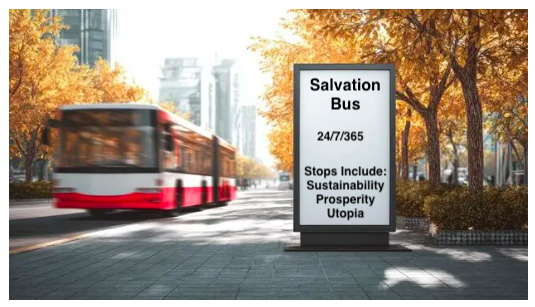
We’re Saved! The Finale: All Aboard the Salvation Bus.
Man is not a rational animal; he is a rationalising animal.
-Robert A. Heinlein
Across the almost two dozen We’re Saved! Contemplations I’ve penned over the last ten months in an attempt to analyse “solutions” to humanity’s predicaments a consistent and damning pattern emerges: these “fixes” are systematically overhyped, fundamentally flawed, and ultimately exacerbate the very problems they claim to solve. Each promised salvation rests upon a structure of psychological defence mechanisms wrapped in language of innovation and progress.
 vecteezy.com (with edits)
The Core Pattern Across All “Solutions”
There appear to be eight fundamental critiques that are applicable to virtually every “solution” that continue to be presented to humanity. Any one of these flaws might be survivable in isolation. Together, they form a death warrant.
Narrative Management via Greenwashing
Every solution is marketed almost exclusively through its supposed benefits while drawbacks are ignored, suppressed, or framed as temporary engineering challenges. The sales pitch used to market the next, greatest “tool” for humanity’s benefaction tends to focus on salvation while overlooking trade-offs and physical limits. As I have asserted: “The suppression of negative aspects and overhyping of supposed ‘benefits’ of products and ideas is commonplace in marketing and clickbait sites, and it seems to infect almost everything nowadays — especially energy production, mass consumption, the pursuit of economic growth, and social media.”
Additive, Not Replacement
Virtually every technology presented as a “replacement” for destructive systems (particularly hydrocarbon- based ones) is actually additive to total human throughput. Hydrocarbon use continues to rise alongside the growth of alternatives. The “transition” story is fictional — a comforting myth. Solar, wind, nuclear, hydrogen, biofuels, bamboo, hemp — all have been added on top of existing energy systems, not displacing them.
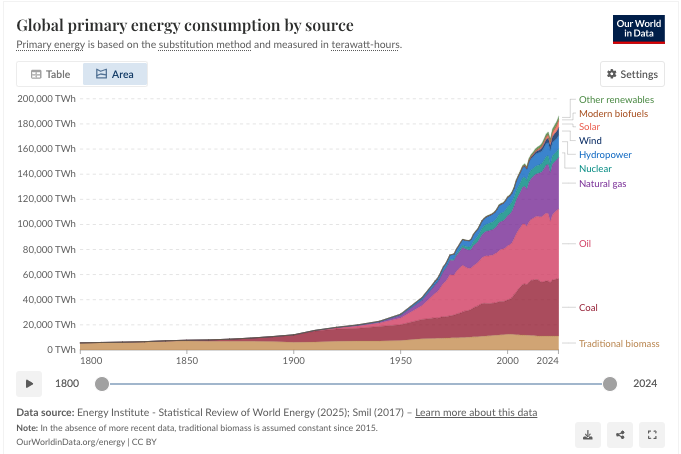 Energy Consumption By Source
Blindness to Scale
What may work in small, local, or organic applications becomes resource-intensive and ecologically destructive when industrialised for global application. Niche applications or tabletop lab successes do not scale up to societal levels without exacerbating the issues they claim to address. I’ve noted repeatedly: “The ‘solution’ has now added to the predicament of overshoot and its various symptom predicaments.”
Carbon Tunnel Vision
Hyper-focusing upon carbon emissions as the primary metric allows proponents to ignore broader ecological destruction: biodiversity loss, waste streams, resource depletion, soil degradation, novel entity pollution, freshwater depletion, and land-use change. This constricted view promotes technological “solutions” that may address carbon but exacerbate several other planetary boundaries already breached. And often, if not always, the supposed reduction in carbon emissions is only possible via generous assumptions and/or incomplete lifecycle analyses in the calculations used to make such assertions.
Faith in Unhatched Chickens
Almost all technological “solutions” rely upon technical breakthroughs that are invariably “just around the corner” — fusion energy perpetually 20–30 years away, next-generation nuclear reactors requiring unproven fuels, hydrogen infrastructure dependent on breakthroughs in storage, carbon capture awaiting scalability, AI efficiency gains predicated on future chips. These always seem to require continual funding in order to sustain hope while avoiding responsibility for failure to meet promises.
Perpetuation of Growth
Every “solution” reinforces the perpetual growth paradigm — the very engine driving ecological overshoot. Business-as-usual expansion is supported without confrontation. Hard discussions about degrowth, simplification, sufficiency, and relocalisation are almost invariably avoided. I’ve been unequivocal: “A society pursuing perpetual growth will turn even the most ‘green’ technology into a tool for further extraction and overshoot.”
Enrichment of the Global Elite
The “solutions” presented as public goods for collective benefit are concentrating wealth (including massive state subsidies) and power to the top of socioeconomic and sociopolitical structures. Continued extraction, industrialisation, and inequality are masked behind anxiety-reducing narratives of collective salvation. The nuclear industry, renewable energy buildout, circular economy infrastructure, and AI development all funnel money upward.
Biophysical Impossibility
Each technology bumps up against the same hard limits: net energy returns that fall below societal maintenance thresholds (estimates range from 7–8:1 for maintenance up to 10–14:1 for full complexity; even the lower figures are out of reach for most renewables once storage is included); finite material/mineral requirements already facing supply bottlenecks and declining ore grades; entropy ensuring waste cannot be eliminated, only deferred; and Jevons Paradox ensuring efficiency gains increase, not decrease, total consumption.

CLICK HERE
If you’re new to my writing, check out this overview.
See my book offer to readers at the end of this Contemplation…
The Thermodynamic Engine: Maximum Power Principle
There is a still deeper driver beneath these eight patterns, one that most solutionists never confront. Ecologist Howard T. Odum called it the Maximum Power Principle (MPP): in competition among systems, those that capture and dissipate the most energy (power) tend to outcompete, survive, and grow. Efficiency is secondary; throughput is primary.
This principle explains why every human society that gained access to a new, denser energy source — wood to coal, coal to oil, oil to natural gas — added it to the existing mix instead of replacing older sources. It explains Jevons Paradox: efficiency improvements lower the cost of energy services, so total consumption increases, not decreases. It explains why “renewables” layered on top of hydrocarbons accelerate total dissipation rather than displacing fossil fuels. A solar panel does not replace a coal mine; it enables more Bitcoin miners, more AI data centres, more electric SUVs, all built with hydrocarbons.
The MPP is not a conspiracy. It is a thermodynamic tendency. Living systems — from bacteria to empires — are selected to maximise their power intake because higher power allows more replication, more territory, more complexity. Our societies are following a deep evolutionary script, not making a rational choice. And that script has no “off” switch except depletion or collapse.
This is why every “solution” that promises to sustain or grow energy supply reinforces the very engine of overshoot. Fusion, if it ever worked, would not save the biosphere; it would power more mining, more manufacturing, more war. The MPP tells us that energy is not a neutral commodity. It is the currency of competition. Adding more currency to a system already in ecological debt accelerates the day of reckoning.
Thus, the eight patterns above are not accidental failures of policy or design. They are expressions of a fundamental law of energy flow. Until we understand that — and accept that our civilisation will not voluntarily power down — the salvation bus will keep accelerating toward the cliff.
The Psychological Foundation: Why Humans Create and Believe Salvation Stories
There exists a profound psychological driver for why our species weaves and clings to narratives about pending salvation. As I’ve argued, “The need to believe tomorrow will be like today and yesterday is strong. Humans despise uncertainty. It creates immense anxiety; a ‘pain’ that needs to be avoided and replaced by ‘pleasure’, if at all possible. If our immediate environment can’t help with this, our minds can. It is in this vein that we seek stories which enable our bodies to decrease our anxiety and the physiological symptoms that accompany it. Particularly comforting are the tales that suggest we have more agency in our existence than we actually do.”
A number of indigenous North American traditions have a name for this psychic blindness: wetiko — a cannibalistic spirit that consumes the life force of others while convincing its host it is doing good. The host does not see itself as monstrous. It sees itself as innovative, productive, progressive. We do not need the supernatural framing to recognize the pattern. Call it cognitive dissonance. Call it denial. Call it the rationalising animal. The result is the same: we eat the future while telling ourselves we are saving it.
As archaeologist Joseph Tainter asserts in his text The Collapse of Complex Societies, human societies are fundamentally problem‑solving organisations. The “problem” with this is that invariably our “solutions” oftentimes (always?) lead to unforeseeable consequences that, given enough time, make the situation worse. Complexity is perhaps the largest reason why. Humans tend to think linearly and have extreme difficulty considering the multilinear aspects of complex systems. Feedback loops. Emergent phenomena. These aspects cannot be predicted with much if any accuracy. And then there are lag times between actions and consequences; sometimes years or centuries, making it next to impossible to connect the dots between our “solutions” and their eventual negative impacts.
Perhaps our greatest adaptive skill — problem solving — is also our worst. It has led us to create complex societies that eventually “collapse” and into ecological overshoot that has put all of humanity at risk. Then there are the land-use changes in addition to chemical and biological wastes that have been created in the wake of our problem-solving, putting every other species in the crosshairs.
The Modern Tendency to Invoke Complex Industrial Technologies
Several specific mechanisms characterise our modern salvation narrative:
Deference to Authority
Humans tend to trust institutional authorities — governments, scientists, corporations, “experts” — who present technological solutions. This trust is conditioned from birth through education, media, and social structures.
Cognitive Dissonance Reduction
Acknowledging that industrial civilisation is unsustainable, that complex societies cannot be maintained indefinitely, and that growth on a finite planet is impossible would produce overwhelming discomfort, anxiety, and grief. Believing in technological salvation is far less painful.
Illusion of Agency
Salvation stories grant the sense that humans can “fix” their way out — that action matters, that control is possible, that collapse can be averted through ingenuity. This illusion is preferable to accepting powerlessness before biogeophysical limits.
Confirmation and Self-Serving Bias
Humans create narratives that confirm existing biases and protect self-esteem, elevating human ingenuity while ignoring dependence on finite resources and Nature. The elite promote these narratives because they support status quo systems from which they profit and gain their power and prestige.
The Elite’s Role in Narrative Management
I’ve little doubt that governing institutions and ruling elites actively manufacture and amplify salvation stories. As I’ve stated: “The elite maintain status quo power and wealth structures not simply through their control of important resources but by way of manipulating societal narratives. Such stories serve to instill the belief that their rule is beneficial for all, and they also tend to be less costly (and perhaps more enduring) than the more oppressive and forceful means our governing institutions have at the ready.”
These narratives include: framing elite self-interest as public good; controlling language and education; creating retainer classes with vested interests in the status quo; using “bread and circuses” to mollify and distract; and managing debate within system-supportive boundaries.
Conclusion: Salvation Stories as Collective Defence Mechanism
The core messages across my We’re Saved! Contemplations that tackle an array of “solutions” are stark, and I’ve mentioned them previously: “No innovation — technological or systemic — can solve the pursuit of infinite growth on a finite planet. Our species is in ecological overshoot having exceeded planetary boundaries across multiple dimensions and the ‘solutions’ being bandied about are not neutral tools but amplifiers of the very systems that are exacerbating overshoot.”
This pursuit is not merely a policy failure or a cultural mistake. It is driven by the Maximum Power Principle — the thermodynamic tendency of living systems to capture and dissipate ever more energy. We are following a deep evolutionary script, not making a rational choice.
Believing in technological salvation is a collective defence mechanism that allows avoidance of uncomfortable truths — especially that complex industrial societies cannot be sustained indefinitely. The narratives grant most people the illusion of agency while avoiding fundamental changes to consumption, extraction, and growth patterns that have led to overshoot.
The real need is not for better technologies but for honest acknowledgment of biophysical limits and engagement with difficult conversations about degrowth, simplification, relocalisation, and harm reduction. These conversations are foreclosed by those who profit from status quo arrangements — but also by well-intentioned people who continue to believe more technology is the best and often the only path forward.
Until humanity can face the anxiety such conversations provoke, it seems destined to continue chasing salvation stories and supporting the destructive technologies that accompany them. And with these, the acceleration of the “collapse” they promise to avoid.
“The human proclivity to create and believe in stories of salvation — especially the modern tendency to invoke complex industrial technologies — is not a rational response to our predicament. It is a psychological evasion. We are not rational animals; we are rationalising animals. And our most dangerous rationalisation is that we can innovate our way out of the consequences of our innovation.”
If I Am to Speak Honestly
I have spent years researching, reflecting, writing, and conversing with anyone willing to step outside the comforting glow of our collective delusions. I have shifted from a deep belief in societal narratives concerning the power of technologies and the “goodness” of government to my present-day extreme skepticism. I have more recently watched as one “solution” after another has been paraded before us: bamboo and hemp, fusion energy, nuclear renaissance, hydrogen, wave power, green steel, ecomodernism, solar photovoltaics, circular economies, artificial intelligence, and good government. I have watched as each one, upon even modest scrutiny, reveals itself not as a saviour but as an amplifier — an accelerator of the very overshoot it claims to address.
The pattern is unmistakable. We humans tell ourselves salvation stories because the alternative is too awful to sit with: that we have built a global civilisation on a finite planet while behaving as if limits do not apply to us. That we are already deep into ecological overshoot, having breached multiple planetary boundaries. That the laws of thermodynamics and ecology are not negotiable. That our complex societies, dependent on ever‑increasing energy and material throughput, cannot be sustained indefinitely.
The evidence has been clear for decades. The Limits to Growth was right. Catton’s Overshoot was right. Tainter’s Collapse of Complex Societies was right. Our governing institutions serve not us but the ruling elite. Our technologies add to, not replace, our destructive habits. Our narratives manage our anxiety, not our reality.
So let me stop pretending. Let me stop offering “might” and “perhaps.” Let me tell you what the evidence, history, and biophysical reality point toward.
The Most Likely Outcome (timeline very approximate)
Short Term (Next 1–10 Years)
Acceleration of the crash. We will double down on every false solution with increasing desperation. Governments will pour trillions more into nuclear SMRs that never arrive on time, into hydrogen infrastructure that consumes more energy than it delivers, into AI data centres that demand ever more electricity while the grid buckles. Renewables will continue to be added on top of hydrocarbons, not replacing them, because the entire industrial metabolism runs on hydrocarbons — mining, manufacturing, transport, construction, disposal. There is no exit ramp.
Resource wars will intensify. The Strait of Hormuz, the South China Sea, the Arctic, the lithium flats of the Atacama, the cobalt pits of the Congo — these will become battlegrounds, not metaphors. Inflation will remain stubborn, driven by declining energy returns and supply chain fractures. Debt will balloon further, then default. Central banks will print and repress, and the purchasing power of ordinary people will collapse.
We will see more blackouts, more supply disruptions, more climate‑driven disasters that overwhelm our already frayed response capacities. Mass migration will increase, and with it, fascist backlashes. Our “leaders” will declare states of emergency, suspend normal processes, and blame external enemies or internal scapegoats — anyone but themselves and their pursuit of the infinite growth chalice. Most people will cling to the hope that “this is temporary” and that the next election, the next technology, the next miracle will save them.
They will be wrong.
And who gets on the salvation bus during this intensifying breakdown of human societies? The elite, of course. They have their private jets, fortified compounds, offshore accounts, and contingency plans. They will buy themselves time — perhaps a few extra years of comfort, perhaps a secluded retreat while the world burns. But even they cannot buy their way past biophysical limits. The bus they are boarding has no destination. The rest of us are left standing on the platform, watching the tail-lights disappear over the horizon, holding tickets that were never valid.
Medium Term (10–30 Years)
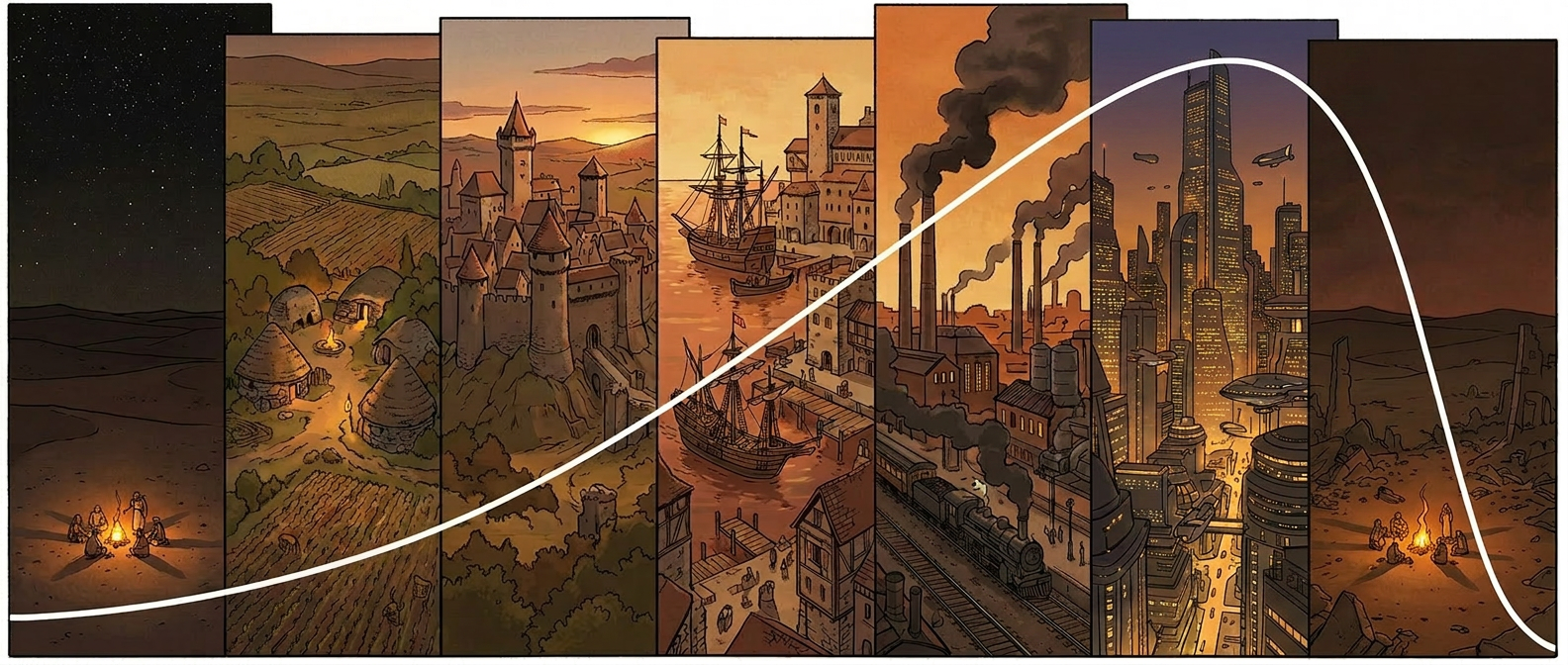
Managed descent becomes chaotic collapse. The term “managed” will prove aspirational. As hydrocarbon net energy declines past the point where we can maintain complex infrastructure — roads, grids, supply chains, healthcare systems — things will begin to unravel in earnest.
 Ugo Bardi
Food production will be hit hardest. Industrial agriculture depends entirely on natural gas for fertiliser, on diesel for planting and harvest, on global supply chains for spare parts and pesticides. When those falter, yields will drop. Not gradually, but in stepwise failures. Localised famines will become regional famines. Urban populations, disconnected from food production for generations, will face hunger and then starvation.
The financial system, already a Ponzi scheme built on perpetual growth, will implode. Not because of a single crash, but because growth itself will stop — and when growth stops, debt becomes unserviceable. Pensions, savings, insurance, all promises written on future extraction, will evaporate. The ruling elite will protect themselves, retreating into fortified enclaves with private generators, private food stores, private security. The rest will be left to fend for themselves.
Nuclear waste stored “temporarily” for 75 years will become a nightmare we can no longer manage. Flooded repositories, abandoned cooling ponds, unchecked radiation leaks — these will be the legacy we leave to the survivors, who will have no capacity to deal with them.
War will not be a choice but a necessity, as nations fight for remaining oil, gas, water, arable land. Nuclear weapons will not be used in a clean, strategic exchange; they will be used in desperation, or they will be stolen, or they will simply decay into hazards. But the wars themselves — conventional, brutal, endless — will consume what little surplus remains.
Biodiversity loss will accelerate to near‑total collapse of many ecosystems. The oceans, already acidifying and warming, will see massive fishery die‑offs. Pollinators will continue to vanish. Soils, already eroded and salinated, will blow away. The web of life that sustains us will fray beyond repair on human timescales.
Most people will still not understand what is happening. They will blame politicians, immigrants, conspiracies, anything except the one thing that is actually to blame: not a decision, but a thermodynamic imperative–the Maximum Power Principle that has driven every living system to capture and dissipate ever more energy. We did not choose more, more, more. It chose us.
Longer Term (30–100+ Years)
A lower‑energy, fragmented, impoverished human remnant. Not a “collapse” into a single event, but a prolonged, uneven, cruel simplification. The globalised, interconnected, high‑technology civilisation we called “modernity” will be gone. Not because we chose to replace it, but because its material basis — cheap, dense, abundant hydrocarbons — will have been “exhausted”, and no combination of “renewables” or “nuclear” or “fusion” will have provided a substitute at the required scale and energy return.
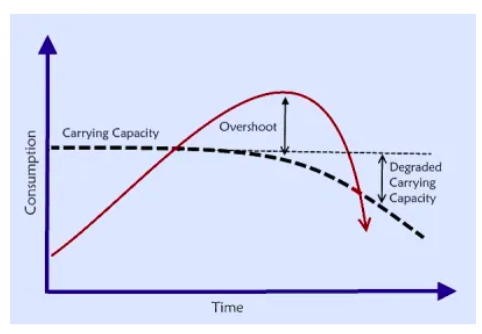
Human population, having peaked sometime in the coming decades, will decline sharply. Not through any coordinated policy, but through starvation, disease, violence, and the simple inability to sustain 8+ billion people without industrial agriculture and global trade. The decline may be 50%, 70%, 90% — I do not know, and neither does anyone else. What I know is that the carrying capacity of a degraded planet without hydrocarbon-based fuel subsidy is far, far lower than our current population.
 Paul Chefurka
What remains will be local, agrarian, small‑scale. Some communities will preserve fragments of knowledge — how to read, how to cast metal, how to treat basic infections. Others will lose everything. Most will live lives that our ancestors from the 1700s would recognise: hard, short, vulnerable to weather, pestilence, and the violence of neighbouring bands.
The long‑term toxic legacies we have created — nuclear waste, PFAS, heavy metals, microplastics — will persist for millennia, poisoning the survivors and their descendants. They will not understand what these poisons are. They will only know that certain places make people sick, that children are born with deformities, that the water sometimes burns.
And they will tell stories about us. About the strange, powerful, insane ancestors who built towers to the sky, who split the atom, who flew through the air, who changed the climate of an entire planet. They will see us as either gods or demons — but most likely as fools. Because we were fools. Clever fools, but fools nonetheless. The story does not include any salvation.
A Final Word
I have been called a pessimist, a doomer, a Cassandra. I am none of these things. I am simply someone who has read the evidence and refused to look away. The recurrent phenomenon of societal collapse — from the Bronze Age to Rome to the Maya — teaches us that complex societies do not “solve” their way out of diminishing returns. They continue to invest in complexity until the returns go negative, and then they simplify, often violently and always painfully.
We are no exception. The only question is how fast, how hard, and how much unnecessary suffering we will add through our continued clinging to salvation stories.
The most likely outcome is not a single apocalypse, but a long, grinding descent — punctuated by wars, famines, and collapses — into a world of far fewer people, far less complexity, and far more suffering than we could have avoided if we had only listened to Nature and its limits. The speed of this descent, however, is likely to be greatly accelerated in comparison to those of past societies whose populations still held the knowledge and skill to be self-sufficient and thus walk away from their collapsing circumstances into relatively unexploited lands and continue on in a simplified way. It’s safe to say that given the present circumstances such opportunities no longer exist and the coming collapse is sure to be cataclysmic in nature compared to past examples.
It’s a fine mess our species has put itself and planet into, and I see no way to avoid the reckoning Nature has in store for humanity.
The harsh truth is we’re not saved because of our ingenuity and technological prowess. We never were. And the sooner we stop telling ourselves otherwise, the more of us might survive to build something smaller, humbler, and maybe — just maybe — a little wiser.
Post-Script
Thus ends (for now) my exploration of “solutions”. While I’ve got a few more in the pipeline and in rough draft form, the writing is on the wall and needs no further emphasis. Either you understand the predicament and how each and every “solution” brought before us is part of a story that serves purposes other than true “salvation” — typically to divert attention away from our plight and/or the associated pillaging of national treasuries by our corporate and political elite — or you don’t.
Overshoot takes no prisoners and the best one can do is try to make one’s community more resilient and self-sufficient while doing as little harm to the planet’s ecological systems as possible.
Special Offer
If you have made it to the end of this Contemplation, I have an offer for you. Send me an email at olduvaitrilogy@gmail.com requesting a copy of Part 1 of my trilogy and I’ll fire off a PDF of it to you for your “fictional” reading pleasure. If you like the beginning of the tale, please consider ordering the trilogy here: Purchase Book(s) — Olduvai.ca.
What is going to be my standard WARNING/ADVICE going forward and that I have reiterated in various ways before this:
“Only time will tell how this all unfolds but there’s nothing wrong with preparing for the worst by ‘collapsing now to avoid the rush’ and pursuing self-sufficiency. By this I mean removing as many dependencies on the Matrix as is possible and making do, locally. And if one can do this without negative impacts upon our fragile ecosystems or do so while creating more resilient ecosystems, all the better.
Building community (maybe even just household) resilience to as high a level as possible seems prudent given the uncertainties of an unpredictable future. There’s no guarantee it will ensure ‘recovery’ after a significant societal stressor/shock but it should increase the probability of it and that, perhaps, is all we can ‘hope’ for from its pursuit.
If you have arrived here and get something out of my writing, please consider ordering the trilogy of my “fictional” novel series, Olduvai (PDF files; only $9.99 Canadian), via my website or the link below — the “profits” of which help me to keep my internet presence alive and first book available in print (and is available via various online retailers).
Attempting a new payment system as I am contemplating shutting down my site in the future (given the ever-increasing costs to keep it running).
If you are interested in purchasing any of the 3 books individually or the trilogy, please try the link below indicating which book(s) you are purchasing.
Costs (Canadian dollars):
Book 1: $2.99
Book 2: $3.89
Book 3: $3.89
Trilogy: $9.99
Feel free to throw in a “tip” on top of the base cost if you wish; perhaps by paying in U.S. dollars instead of Canadian. Every few cents/dollars helps…
https://paypal.me/olduvaitrilogy?country.x=CA&locale.x=en_US
If you do not hear from me within 48 hours or you are having trouble with the system, please email me: olduvaitrilogy@gmail.com.
You can also find a variety of resources, particularly my summary notes for a handful of texts, especially William Catton’s Overshoot and Joseph Tainter’s Collapse of Complex Societies: see here.
[…] in a long line of salvation narratives of the kind I have explored in recent contemplations (see: Website Medium Substack). The structure is by now familiar: identify a planetary emergency, propose a […]