Today’s Contemplation: Collapse Cometh CCXXV–
We’re Saved! Carbon Emissions Have Decoupled From Economic Growth.
In a recent article, energy analyst Art Berman critiques a report put out by The Energy & Climate Intelligence Unit (ECIU) regarding the notion of ‘decoupling’. I found this a timely article given I had already begun to think about doing another in my We’re Saved! series of Contemplations looking at the concept of ‘decoupling’ after reading an article by Matt Orsagh who writes at Degrowth is the Answer.
Before looking at Matt’s piece and raising Art’s critique, let me begin with some context for the discussion on them. After which, I am going to expand on their points with some of my own thoughts.
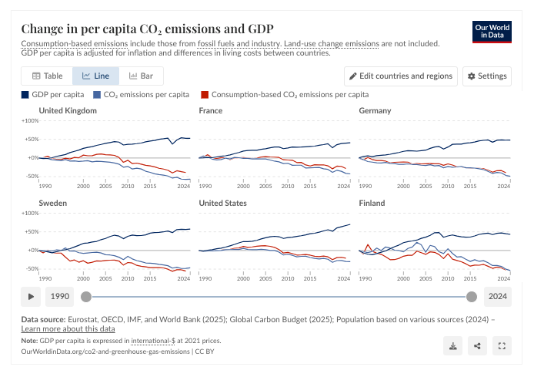 Decoupling
‘Decoupling’ is fundamentally referring to two things becoming disconnected from one another. When discussing economics and the environment, it is a buzzword for many in the ‘sustainability’ movement and for those concerned with anthropogenic climate change. It typically refers to greenhouse gas emissions (primarily carbon dioxide) ‘decoupling’ from economic growth (typically measured by Gross Domestic Product (GDP)). Simplistically, it refers to carbon emissions falling or expanding at a rate slower than the growth of the economy.
Some speak about a more complex and expansive ‘decoupling’ where a broader scope of environmental impacts are ‘decoupled’ from economic growth, not just emissions but where we witness less energy use, lower resource extraction, and reduced pollution. Similar to the simpler version, those who use it tend to aim for endless economic growth while minimising or eliminating planetary destruction. Most analyses and commentaries, however, tend to focus upon the ‘simpler’ connection between carbon emissions and economic growth, and not the broader ecological aspects.
‘Relative’ and ‘Absolute’
‘Decoupling’ can be ‘relative’ in that emissions are growing but at a rate slower than the economy. In such cases, the ‘decoupling’ is considered weak but not broken. Planetary damage is still occurring, just at a slower pace. This is the more common form when spoken about.
When ‘decoupling’ is ‘absolute’, it refers to emissions falling while economies are growing. This is the type that many climate activists/environmentalists get excited about and set as the ultimate goal. ‘Absolute decoupling’ is the holy grail of those advocating ‘green growth’.
How Does ‘Decoupling’ Occur?
‘Decoupling’ can take place through a variety of mechanisms. First, energy efficiency–where less energy can produce the same economic output–can bring on such ‘decoupling’. A structural change in the economy can also lead to it, with an example being shifting from certain carbon-intensive industries (e.g., cement and steel production) to service- or knowledge-based ones (e.g., finance, healthcare). Switching fuels can, given enough time, also reduce emissions, such as replacing coal with natural gas or nuclear or solar photovoltaic. Finally, societal policy and regulation can reduce emissions, such as carbon taxes or cleaner technology standards.
National ‘Decoupling’
Proponents of the ‘decoupling’ narrative point to real, documented drivers behind emissions reductions in some nations. Reports from statistical agencies attribute national declines to specific policy frameworks, the rapid build-out of ‘renewable’ energy capacity that is replacing more carbon-intensive forms of energy, gains in energy efficiency, and shifts towards service sectors and away from industrial-based ones.
Why Is It Important?
‘Decoupling’ is believed by many to be very important as it demonstrates that prosperity through economic growth can continue without harming the planet and take place within planetary boundaries. What has become known as ‘green growth’ is entirely within our capability, if we simply do the ‘right things’.
Perpetual economic growth and associated ‘progress’ in balance with Nature. What’s not to like?
Well…

If you’re new to my writing, check out this overview.
Criticism Abounds
The idea of emissions ‘decoupling’ from economic growth and related concepts have come under critical scrutiny given the importance of narratives around human progress, economic growth, ecological systems impacts, biogeophysical limits, and planetary boundaries.
It is crucial to engage directly with the evidence proponents use to support their claims. A 2024 study in Scientific Reports that analysed 164 countries found that 49 had achieved some form of ‘decoupling’ but the rest had not. The ECIU report mentioned at the outset claimed economies representing 92% of global GDP had demonstrated ‘decoupling’. It is this type of data that fuels and supports the optimism of ‘green growth’. Such success, however, is geographically limited, observed predominantly in wealthy nations, and–as the following critiques will show–is often based upon accounting that hides more than it reveals. A pertinent question, then, is not if decoupling can be measured in select places but if what is occurring is sufficient, genuine, and global.
Decoupling: Don’t Get Your Hopes Up
Matt Osargh’s post is a critique regarding an article that appeared in the Guardian reporting on the same ECIU analysis that Art Berman critiques in his post.
The Guardian article is what I would characterise as a regurgitation of the ECIU’s claims with no in-depth or critical analysis: it simply accepts and reports the findings. It highlights exactly what the ECIU report argues: economic growth has ‘decoupled’ from emissions across nations that represent 92% of the global economy; this trend is pronounced in ‘advanced’ economies and shifting in the right direction for others; and, it is the result of governmental policies and regulations, as well as a quickening energy transition.
As Matt points out, the Guardian was quick to highlight the ECIU’s claim that a number of high-consumption nations had achieved ‘absolute decoupling’ from economic growth as measured by GDP. Matt takes exception with that declaration (and especially the headline wording) arguing that such claims are not just misleading but create dangerous and false hope as well as distracting from more fundamental societal shifts that are needed to address our climate crisis.
He goes on to argue that while there is evidence to suggest that the link between GDP and emissions is weakening, the way the data is presented implies the issue is ‘solved’; which it is not. Only half the countries in the report achieved decoupling in ‘absolute’ terms, while the other half showed it in ‘relative’ terms. More problematic, however, is that the report only focussed upon ‘consumption-based carbon emissions’ and excluded major carbon emission sources such as those that occur as a result of land-use changes or deforestation.
But even if we accept the claims of the report, Matt contends that the scale and speed of ‘decoupling’ is not occurring at a rate fast or large enough to meet climate targets. And Matt wonders if large-scale ‘decoupling’ is even possible. He cites a 2019 review that the European Environmental Bureau carried out and which did not find any empirical evidence of such ‘decoupling’. 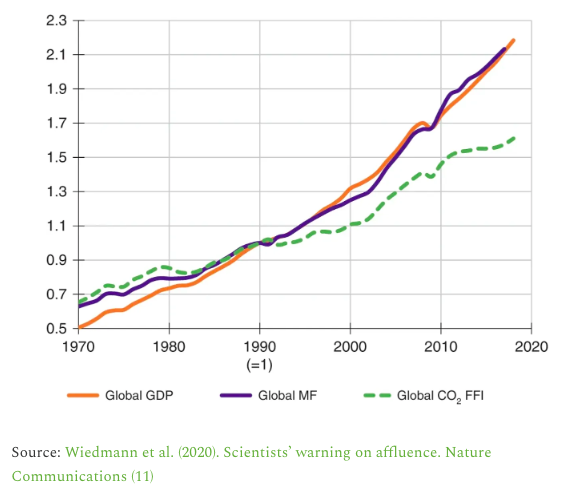 Matt further argues that if one looks at global material resource use (MF in the above graph; which requires significant ecological destruction, including emissions), GDP has correlated tightly with this measure for more than a century.
Matt concludes with the argument that the ‘green growth’ techno-optimists claim is possible and occurring is a fantasy. Instead, the world needs to embrace degrowth since the pursuit of economic growth is “false, ridiculous and self-destructive”. Humanity needs to prioritise well being and ecological limits as opposed to perpetual economic expansion. False hope needs to stop being offered and the difficult truth that our economic systems need to change dramatically must be confronted.
Dumb and Dumber
Art Berman’s post also critiques the claims made in the ECIU report, pointing out that their assertions are not only misleading but based upon flawed accounting and does not indicate genuine physical progress towards ‘decoupling’.
Art argues that the conclusion reached by the ECIU is false because it relies upon consumption-based emissions data and fails to account for advanced economies that import many goods where the emissions are ‘counted’ in the producing country’s ledger, not the importing one. This is an accounting trick that allows importing nations to appear as if their emissions are falling when in fact they are simply shifting them to another nation.
Art maintains that there is no ‘decoupling’ occurring from a physical systems perspective. Emissions continue to rise globally and reductions in some nations are offset by increases in others. The past 35 years shows a strong correlation (0.82) remaining between GDP and carbon emissions with no change in this trend despite decades of policy changes and ‘green’ technology. Mitigation attempts (e.g., electric vehicles, ‘renewable’ energy) have not changed this trajectory. 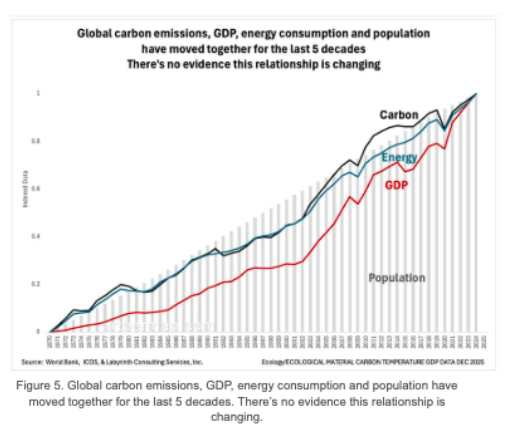
Art contends that the ECIU’s report is motivated by institutional self-preservation and via the creation of a comforting narrative where a number of beliefs can be held simultaneously: climate change is real; perpetual economic growth can continue; and, current policies are adequate to address climate change concerns. He further argues that only the first of these three beliefs is true.
Art concludes by calling for honesty around these topics and their related issues. The illusion of progress towards ‘decoupling’ via accounting tricks is “biophysically meaningless”. Humanity needs to be honest regarding the hard, physical constraints that exist on a finite planet and the implications of this for our economic systems, not lying to itself with cherry-picked data.
These two essays examine critically the claim that carbon emissions and economic growth have ‘decoupled’. They share a core skepticism but differ in their arguments, evidence, and what to do in light of the issue.
Despite approaching the issue from different but complementary angles, they arrive at the same conclusion: ‘decoupling’ is a dangerous myth. Matt provides what can be considered an ideological and moral case for moving beyond growth, framing the issue as one of false hope and the need for systemic change. Art, on the other hand, uses the physical and data-driven evidence to show how the claim is an ‘accounting trick’ that conflicts with biophysical reality.
Together, they provide a powerful critique that the ‘decoupling’ narrative is physically unfounded while being politically obstructive and delaying the needed systemic and societal shifts necessary for a stable climate–let alone a broader array of ecological impacts that are ignored by those making claims about ‘decoupling’ taking place.
I wish to add a few more thoughts on the idea of ‘decoupling’ that some claim is occurring; or will at any moment, if we simply employ the correct policies and/or technologies.
Gross Domestic Product (GDP)
Many experts and institutions argue that the use of GDP as the metric to base ‘decoupling’ on is extremely problematic and, as we can see from the two articles presented above, creates a misleading picture.
GDP is fundamentally a measure of economic transactions that excludes both societal well-being and environmental health; the latter being core to the arguments for ‘decoupling’. This undermines its ability to be effective as an indicator of ‘sustainability’.
Ecological Blind Spots
GDP’s core flaw is that it carries with it significant ecological blind spots. It measures economic activity without any consideration if the activity is beneficial or detrimental to the planet’s ecological systems.
In fact, activities that are clearly environmentally harmful (e.g., deforestation, hydrocarbon extraction and consumption, mining, land-use changes) are considered economic gains; the negative impacts are not part of the equation. Dispersal of pollutants and toxins are not counted as a ‘cost’, but the activity to clean up environmental disasters such as chemical spills is seen as a contribution to GDP. And, resource depletion is ignored; natural resources are viewed as infinite income and not finite capital assets.
This flawed accounting impacts how growth and emissions data are interpreted. Progress towards ‘decoupling’ gets grossly overstated in a nation that has off-shored much of its carbon-intensive industries but has a rising GDP while importing industrial goods from others. Incentives can get misaligned when polluting activities contribute to the economy, creating a situation where policy shifts to help with long-term sustainability–such as pursuing degrowth–are frowned upon, if not denigrated. Finally, other forms of ecological systems degradation are masked when GDP growth is sustained by industries that might be less emissions-intensive but lead to issues that are not captured (e.g., biodiversity loss, water and/or air pollution, ocean acidification).
Debt and Financialisation
GDP-based ‘decoupling’ claims are further weakened and distorted due to monetary aspects of our economies.
Debt, especially when used to finance growth, creates a link between GDP, emissions, and financial expansion that challenges the very idea that ‘decoupling’ of economies can easily occur if we just ‘do the right thing’.
A recent study that modelled debt-financed growth and ‘carbon lock-in’ for four advanced economies found a strong relationship between cumulative GDP, debt accumulation, and cumulative emissions. Debt-driven growth was found to amplify emissions due to high-carbon trajectories being locked-in because of the need for sustained growth to service the debt. Credit-driven growth regimes challenge the very feasibility of ‘decoupling’. And world debt has done little but significantly grown in an exponential fashion across the planet, meaning significant exponential economic growth is required.
The study further notes a macroeconomic rebound effect where a positive feedback loop is created between credit expansion and carbon-intensive industries. Even where debt is used to expand ‘clean’ energy and boost GDP, higher emissions occur not just from the industrial activities associated with mass-producing the non-renewable, renewable energy-harvesting technologies but via increased consumption.
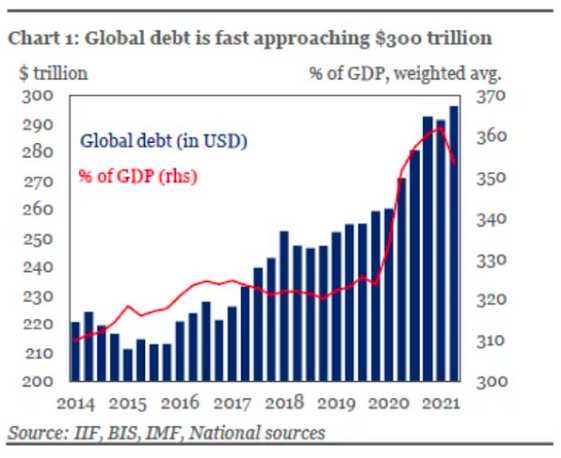
Similar to issues surrounding debt, the increasing growth of economies–as measured by GDP–via the FIRE sectors (i.e., finance, insurance, and real estate services) influences significantly the GDP-emissions link in a fashion that distorts perceived environmental improvements.
The financialisation of economies that occurs as a result of the growth of these sectors in most (all?) advanced economies has been substantial. And when combined with the off-shoring of carbon-intensive industries, ‘decoupling’ of a growing GDP from emissions can seem to be in a positive light.
This is not a systemic improvement, however; it is a sectoral shift. A recent study that examined this phenomenon across 172 nations from 1960-2014 found that while per capita GDP and emissions ‘decoupled’, it did no such thing in relation to growth from manufacturing. The absolute and negative impacts on the environment from manufacturing and their associated emissions tended to be maintained or actually grow: ’decoupling’ was the result of growth in the FIRE sectors combined for some nations with the off-shoring of manufacturing.
The financial transactions that take place within the FIRE sectors contribute significantly to GDP without corresponding emissions increases. All this is doing, however, is inflating the economic aspect of the ‘decoupling’ ratio. It’s a statistical improvement that masks the continued and oftentimes increasing environmental degradation via the industrial-based economy (especially in those nations whose manufacturing industry sector is increasing as a result of other nations decreasing theirs). 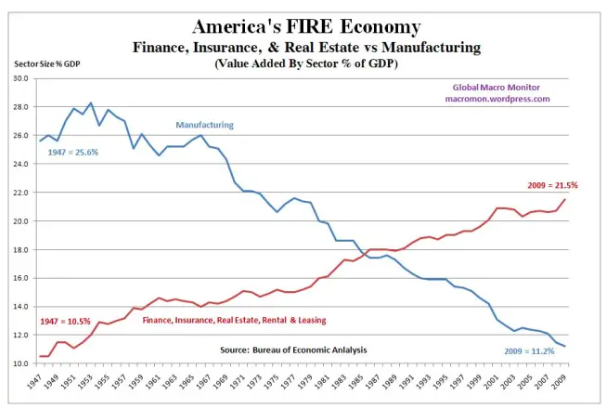 Global Macro Monitor
The expansion of debt and finance-based sectors greatly undermine the claim about ‘decoupling’ in most nations that make it. In fact, combined, these aspects reveal the limitations of the narrative completely.
Debt-driven growth actually leads to structural ‘coupling’ due to repayment requirements. Apparent ‘decoupling’ may be totally illusory (or temporary) as the perpetual growth that is needed to occur will result in future emissions, with greater and greater emissions occurring as the interest on debt compounds. Increases in the financial transactions of the FIRE sectors do result in a statistical ‘decoupling’ but not in the material manufacturing sector that result in the lion’s share of environmental impacts.
This highlights that a rising GDP can be driven by financial mechanisms almost completely detached from or contradictory to actual environmental sustainability. This brings to mind the saying: There are lies, damned lies, and statistics.
Reification
The phenomenon of treating abstract concepts like concrete, measurable entities is known as reification. It is a concept I first became aware while in university when I read the late Stephen Jay Gould’s critique of the concept of biological determinism and the notion that economic and social differences between human populations are due to inherited traits; Gould used it when discussing intelligence as viewed through intelligence quotients (see: The Mismeasure of Man).
Reification is a process that occurs when an abstract concept or idea is treated as though it were a concrete and physical thing. Something immaterial becomes a physical ‘thing’ with the appearance of natural existence. When we ‘reify’, we lose sight of the fact that the thing we are discussing is a human-created and abstract system or idea; we begin to view it as an unchangeable thing beyond our control or influence.
This process takes place all the time. In capitalist societies, for example, we tend to view the economic system as consisting of objective and natural laws to be obeyed, and not as a historically created human system. And, as Gould argued, in psychology when we view intelligence as a measurable entity and give it a number. The common thinking about GDP is a perfect extension of this.
GDP began as an abstract and statistical tool to measure the economic activity of a nation. The calculation of it was based upon the market value of goods and services produced within a specific timeframe. It was a model of one aspect of an economy. (See: here)
Over the decades since its introduction, the concept has become reified. As we can see through some of the discussion above, it is now treated not as a descriptive measurement but as a concrete thing and goal to be pursued. We have masked the human construction involved, such as what counts as ‘productive’ and what doesn’t, and forgotten that these are subjective, arbitrary, and value-laden choices.
We have turned an abstract concept into an ‘objective and natural entity’. It is treated as a measure of progress while ignoring the ecological damage left in its wake. This allows us to turn negative impacts of our economic activities (e.g., oil spills, pollutant dispersal) into positives (i.e., GDP increase/economic growth) when we engage in activities to counter these impacts.
Why is the reification of GDP problematic? Well, there are profound effects when we view GDP as an objective and concrete gauge of national well-being rather than the narrow one of economic output that it is.
First, governments in particular but also other institutions become compelled to prioritise policies that encourage perpetual growth of GDP. They seek to encourage large-scale projects and stimulate consumption, and often at the expense of other goals–particularly environmental sustainability. Increase of this abstract metric becomes the guiding objective. And governments are not shy at all about connecting this to ‘progress’ and taking on significant debt to achieve it.
By connecting GDP to progress and the well-being of society, our current form of market capitalism becomes seen as the most natural and rational path. Alternative economic systems that might prioritise a more stable and sustainable trajectory over the endless growth we are currently chasing becomes viewed as contrary to ‘economic laws’. GDP becomes not only the arbiter of socioeconomic systems but also social arrangements.
The reification of GDP also serves to disconnect us from what matters. Society’s members view personal well-being, much like their nation’s success, via this number. Feelings of prosperity become connected to it, regardless of personal job security, health, and community resilience. Human experience becomes subordinated to this abstract measure.
‘Decoupling’ Reified
Not only has GDP become reified, but the idea of ‘decoupling’ has similarly fallen prey to this phenomenon. An extremely complex statistical relationship between an economic metric (GDP) and an emissions measurement has increasingly become viewed as a concrete thing that has been serving to direct policy goals, especially the primary one of economic growth; while its limitations are hidden, obscured, and even ignored.
Much like the economic activity metric GDP, ‘decoupling’ the drivers of emissions has become reified into a goal that could be labelled ‘green growth’ and has helped to further GDP growth as a non-negotiable policy. While this notion of ‘decoupling’ arose first, it has become tightly associated with the descriptive framework called the Kaya Identity that attempts to analyse the relationship between a number of important variables (i.e., energy, GDP, carbon intensity, and population) so as to identify the drivers of emissions; which has aided in the reification of ‘decoupling’.
Its reification masks not just the very messy complexity behind the statistics involved, but the choices made along the way as to what gets ‘counted’ and what doesn’t. Reified ‘decoupling’ also can become a self-fulfilling prophecy where models only assume continuous GDP growth as an input regardless of biogeophysical planetary limits and constraints. As a result, the question as to whether perpetual growth is even possible on a finite planet shifts to a naturalised growth imperative asking how do we ensure continued growth.
As the discussion above demonstrates, however, there exists a gap between this reified and relatively simplistic notion of ‘decoupling’ and the complexities of the physical world. Accounting illusions, continued global positive correlation between GDP and CO2, and research that shows most advanced-economy emissions reductions since for the past 200 years have occurred as a result of economic recessions and not ‘green growth’ are just a sampling of this.
Carbon Tunnel Vision and Resource/Energy & Ecological Blindness
I penned a three-part Contemplation series on the blind spots that exist for many when it comes to energy/resources and ecology along with the phenomenon of carbon tunnel vision (see: Part 1, Website Medium Substack; Part 2, Website Medium Substack; Part 3, Website Medium Substack), and these blind spots certainly apply to the narrative about ‘decoupling’ carbon emissions from economic growth.
In these previous essays I basically argue that the hyperfocus upon carbon emissions and climate creates a perspective that overlooks broader and more severe symptom predicaments of ecological overshoot (e.g., biodiversity loss, soil degradation, novel entity pollution). This constricted view leads to a promotion of technological ‘solutions’ (e.g., non-renewable, renewable energy-harvesting technologies, electric vehicles) that ‘may’ address carbon emissions but exacerbates several other of the very important planetary boundaries.
In addition, society tends to be blind to the energy inputs (particularly the one-time cache of cheap and dense hydrocarbons) necessary to support our many complexities (e.g., food production, complex material supply chains, mass industrial production). Instead of attributing our complexities–what some would refer to as ‘progress’–to these hydrocarbons, we have created stories to elevate the importance of our species’ ingenuity and technological prowess while also failing to recognise our dependence upon these and other significantly important finite resources.
Finally, a similar blindspot exists with respect to our life-supporting ecological systems. Systems that have been and are being degraded far beyond their natural limits. Many of the planetary sinks that would compensate for perturbations in the natural environment have become overloaded and can no longer perform their function. To say little about the impact upon the many non-human species as a result of our expansion into and destruction of their habitats.
These blindspots are the result of human psychology. We not only create narratives to confirm biases but to protect our self-esteem. We display both confirmation and self-serving bias to elevate our sense of control and ingenuity through these stories rather than acknowledge our dependency on finite resources and nature. Those at the top of societies’ wealth and power structures promote these narratives as they support status quo systems (that they profit from) and because addressing overshoot would require degrowth that threatens these structures.
In summary, this ‘series’ hopefully demonstrates that arguing about which industrial technology will ‘save’ us is quite meaningless within the perspective that we are will into ecological overshoot. Mitigation of this overshoot via a drastic reduction in scale and complexity of our societies and relocalisation of important survival mechanisms (especially food production and potable water procurement) may be humanity’s only viable path. But there exist powerful narratives and cognitive biases working hard to help us deny this reality.
Application to ‘Decoupling’
Applying this theme to the claim of ‘decoupling’ reveals that it is a dangerous and quite illusory narrative reflective of the cognitive biases just highlighted above.
It is perhaps the ultimate expression of carbon tunnel vision. It is hyperfocussed upon carbon emissions and ignores the wider predicament of ecological overshoot. The ‘green growth’ the ‘decoupling’ narrative attempts to justify would serve to accelerate planetary boundary breaches through its material and energy throughput of economic growth. It serves to treat a single symptom (not very well given the evidence to the contrary), while feeding the disease.
The ‘decoupling’ narrative is further founded upon energy blindness that ignores physical reality. It holds that technology and efficiency will sever a historic link between economic growth and energy use while misattributing the growth to human ingenuity rather than the subsidy provided by hydrocarbons. It ignores that the ‘green’ technologies it advocates are extremely energy- and resource-intensive products only available because of the hydrocarbons it is seeking to supplant. Further, it overlooks the Law of Diminishing Returns and Rebound Effects. And, it appears to be a thermodynamic fairy tale used to justify business-as-usual through its contention that infinite growth is quite possible on a planet with biogeophysical limits.
Finally, the ‘decoupling’ story should be seen for what it is: a tale told to protect status quo power and wealth structures. It is a socially-constructed narrative designed to serve specific interests. It promises endless economic growth, creates new markets via ‘green’ technologies, and ensures revenue streams for the ruling elite.
Concluding Thoughts
‘Decoupling’ is very appealing because it reinforces our self-serving biases and desire for agency. Our species is so ingenious we can pursue infinite growth on a finite planet without sacrifice, something most wish given how deeply invested in the current economic paradigm we are. By focussing on the visible products, the ecological destruction being created behind the scenes can remain hidden–out of sight, out of mind. Blind to what is behind the curtain, most will find the narrative entirely plausible.
Unfortunately, the ‘decoupling’ story in supporting ‘green growth’ worsens our fundamental predicament of ecological overshoot. It accelerates our breaching of the various planetary boundaries and postpones actions that would help to mitigate the consequences of this overshoot. It is not a rational policy goal but a collective psychological defense mechanism created through energy blindness and carbon tunnel vision by those in power to make infinite growth on a finite planet appear entirely plausible.
The narrative of ‘decoupling’ a growing economy from carbon emissions is the quantitative cornerstone of a larger, flawed ‘green economy’ paradigm. This paradigm is apolitical, relying on technological fetishism and market mechanisms like carbon credits to commodify nature further, rather than confront the fundamental political conflicts over distribution, limits, and power that ecological overshoot demands we address.
Perhaps it is little more than “a tale told by an idiot, signifying nothing” and belongs in the garbage bin of salvations that are constantly and repeatedly championed by profit-seeking interest groups and those intent on maintaining and/or expanding status quo wealth and power structures at the expense of the planet’s biosphere and all its inhabitants. It needs to be confronted and challenged like all the other similar saviours being used to justify perpetual economic growth while ignoring the negative consequences that accompany this quest.
Recent and relevant articles:
The Consumption Conundrum | ZeroHedge
The Metacrisis Is Metaphysical: The Fallacies That Doom Our Solutions | Art Berman
The Kinetic Solution: Why the ‘Solar Victory’ Requires Gunboats
#97 Matt Orsagh: Is There a Case for Degrowth? | Frankly Speaking Podcast
DOE orders Indiana coal units totaling more than 950 MW to run past retirement dates | Utility Div
The Weight of Light: Why Infinite Energy Cannot Fix Finite Matter [EARLY ACCESS]
Electric Vehicles and Nuclear Power Are Fighting Over One Obscure Mineral | OilPrice.com
USA is the worst pirate on Earth: Trump is stealing Venezuela’s oil
The end of 2025 must be the end of the inane rule of climate ‘optimism’ – resilience
Coal Remains King in India While Exports Optimize Domestic Stock | OilPrice.com
Visualizing All Of The World’s Oil Reserves By Country | ZeroHedge
Wetiko: The Psychosis Eating The World Alive
Why Lists of Extinctions Travel Farther Than Explanations
What is going to be my standard WARNING/ADVICE going forward and that I have reiterated in various ways before this:
“Only time will tell how this all unfolds but there’s nothing wrong with preparing for the worst by ‘collapsing now to avoid the rush’ and pursuing self-sufficiency. By this I mean removing as many dependencies on the Matrix as is possible and making do, locally. And if one can do this without negative impacts upon our fragile ecosystems or do so while creating more resilient ecosystems, all the better. Building community (maybe even just household) resilience to as high a level as possible seems prudent given the uncertainties of an unpredictable future. There’s no guarantee it will ensure ‘recovery’ after a significant societal stressor/shock but it should increase the probability of it and that, perhaps, is all we can ‘hope’ for from its pursuit.”
If you have arrived here and get something out of my writing, please consider ordering the trilogy of my ‘fictional’ novel series, Olduvai (PDF files; only $9.99 Canadian), via my website or the link below — the ‘profits’ of which help me to keep my internet presence alive and first book available in print (and is available via various online retailers).
Attempting a new payment system as I am contemplating shutting down my site in the future (given the ever-increasing costs to keep it running).
If you are interested in purchasing any of the 3 books individually or the trilogy, please try the link below indicating which book(s) you are purchasing.
Costs (Canadian dollars): Book 1: $2.99; Book 2: $3.89; Book 3: $3.89
Trilogy: $9.99
Feel free to throw in a ‘tip’ on top of the base cost if you wish; perhaps by paying in U.S. dollars instead of Canadian. Every few cents/dollars helps… https://paypal.me/olduvaitrilogy?country.x=CA&locale.x=en_US
If you do not hear from me within 48 hours or you are having trouble with the system, please email me: olduvaitrilogy@gmail.com.
You can also find a variety of resources, particularly my summary notes for a handful of texts, especially William Catton’s Overshoot and Joseph Tainter’s Collapse of Complex Societies: see here.