Today’s Contemplation: Collapse Cometh CCXXIX–
We’re Saved! Pulling It Together…So Far.
After my previous We’re Saved! Contemplation (see: Website Medium Substack)–another in my series that has attempted to pull the curtain aside on excessively-hyped ‘solutions’ to our various predicaments–I couldn’t help but notice that there are a number of commonalities in the critiques for the technologies and systems that I have reviewed so far.
In this relatively short synopsis I tie these together and create a series of questions for myself (and others) to use going forward when assessing proposed ‘solutions’ to our various predicaments.
Commonalities
First, there is a good deal of not only overhype but greenwashing and narrative management by marketers and other techno-optimists regarding what these technologies are capable of achieving. Almost all are presented to society through a ‘sales-pitch’ lens that focuses exclusively upon supposed benefits while ignoring or suppressing hurdles and drawbacks. As a result, an oversimplified and comforting tale is put out to the public–one that immediately appeals to most people’s desire for painless ‘solutions’ to the problems and predicaments we find humanity facing.
Although the technologies reviewed are typically presented as a replacement for destructive systems (e.g., hydrogen-based power in place of hydrocarbon-based power for energy systems), they are tending to be additive to our extractive and ecologically-destructive industrial processes. As we are increasing our overall energy demand and material throughput via these supposed less-destructive technologies, the ‘transition’ story we are being sold is actually one of expansion and not replacement. The marketing and amplification of the supposed benefits of these technologies has led to the creation of a transition ‘myth’. A myth that has taken on a life of its own and been increasingly accepted as reality–including by some very well-intentioned individuals and groups.
Third, while there may be local benefits derived from small-scale or organic applications for some technologies, once any attempt is made to scale the system up to industrial levels for global use the social and ecological costs explode. Be it massive resource inputs, logistical systems, waste production, and/or environmental impacts, the ‘solution’ almost always turns into a new and larger ‘problem’; and one that exacerbates the very issues attempting to be addressed in the first place. These scaling issues are rarely if ever raised by the marketers and advocates of these technologies who, instead, focus on the small-scale benefits and imply that if performed on a global level the benefits will still manifest themselves.
Fourth, the evidence used by marketers and advocates to support the hyped benefits tends to focus upon a single metric (almost always carbon emissions) and ignores full lifecycle and broader impacts. Such tunnel vision leads to blindness regarding embodied energy and carbon (often for the infrastructure required), the wider ecological and social costs, and resource depletion.

If you’re new to my writing, check out this overview.
Success based upon as-yet-to-hatch technological chickens is also a common theme. Hypothetical future ‘breakthroughs’ are required for many of the more complex technologies in order to live up to the promises made by marketers and supporters–and the highlighting of such potential is often accompanied by a request for further funding to support research. This faith in techno-salvation that lies just over the horizon distracts from actions that could be taken today that might help to mitigate the consequences of our predicaments, such as slowing or even reversing significantly our overconsumption and the ever-present pursuit of growth.
Everything reviewed so far has served to reinforce growth and elite interests. The technologies being sold as ‘solutions’ are not neutral tools to help all members of society. They are tools that help: legitimise the perpetual growth paradigm; create or expand revenue streams for the elite; and, sustain sociopolitical control by suppressing social anxieties around the biophysical limits to growth, thus avoiding discussions on reining in growth, simplification, and a decentralisation of power.
Seventh, all the technologies bump up against biophysical reality, including: diminishing or lower returns for new sources of energy; net energy issues once full lifecycle costs for the system and its associated subsystems are factored in, with many having very low or even negative energy returns; and, entropy and its unstoppable consequences, with the additional energy they provide actually accelerating the process and its impacts.
Finally, there is Jevons Paradox where increasing efficiency or new energy sources almost always leads to increased consumption. Achieving the Holy Grail of cheap and abundant energy would not in the end solve overshoot, but exacerbate it by loosening the constraints on our consumption and the extraction necessary to feed it.
An Evaluative ‘Questionnaire’
In assessing any technology, system, or proposed ‘solution’, I offer the following questions to ask in order to get a glimpse behind the curtains that over-hyping marketers and over-enthusiastic supporters are consistently hanging.
Narrative
Does the proposal discuss the major drawbacks such as environmental and/or social costs, or only its benefits? Is there irrefutable evidence that the ‘solution’ will replace the destructive technology/system it is proposing to, or is it merely adding to total human throughput? Are the benefits of small-scale applications being honestly applied to a global, industrial scale, or are they being disingenuously applied?
Biogeophysical Reality
Does the analysis of the inputs of the ‘solution’ and any required supplementary technologies and/or systems include all lifecycle stages, in particular: raw material extraction; manufacturing; transportation; operation; maintenance; byproduct disposal; decommissioning; reclamation; end-life disposal and waste management; and, associated infrastructure needs?
What is the net energy return over the entire lifecycle, and is it greater than 10-14:1 (societal maintenance) or 3:1 (basic survival)? What finite materials/minerals are required, and are these readily available or have they already encountered supply chain bottlenecks, diminishing returns, or severe depletion?
What are the ecological blind spots? Is it being assessed through carbon tunnel vision or is it taking in a broader consideration of the various planetary boundaries?
Can the waste it is generating be safely managed in perpetuity, or are there long-term liabilities being created? Is the planetary sink that might help to mitigate any waste already overloaded or close to it?
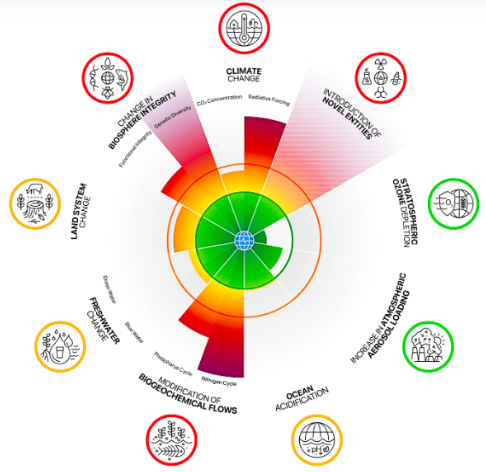
Potsdam Institute for Climate Impact Research
Viability
Can the ‘solution’ survive without massive government subsidies, externalised costs, or loan guarantees? Does it require a new, massively complex, and resource-intensive infrastructure to bring it to fruition? Is it dependent upon ‘breakthrough’ technology that has yet to exist or is only in the prototype stage?
Social Aspects
Does the ‘solution’ challenge the infinite economic growth paradigm or enable its continuation? Who is promoting it and who profits from it? Will it help to further concentrate wealth/power or help to distribute it? Does it challenge or reinforce status quo wealth and power structures?
Does it promote relocalisation and community resilience, or does it require globalised, centralised, and fragile supply chains? Does it shut down discussion of more fundamental changes (e.g., degrowth, simplification), or is it presented as the only alternative within the current system of continued growth?
Conclusion
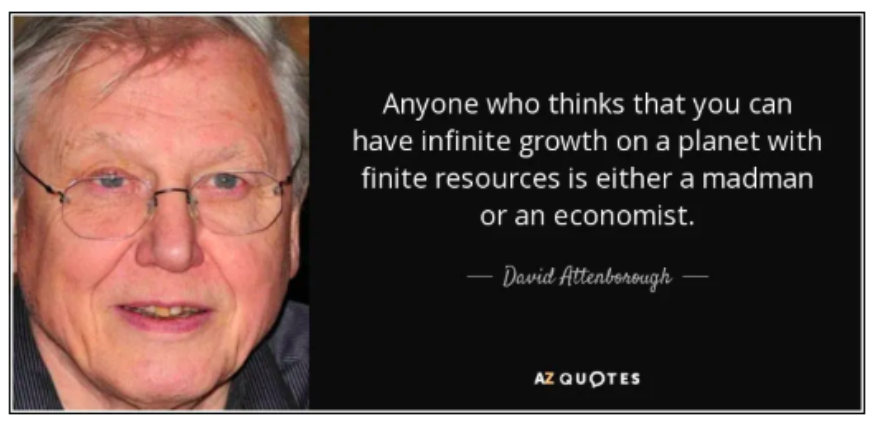
If there is a unifying theme so far in these We’re Saved! Contemplations, it’s that no technological or systemic innovation can solve the predicaments created by the pursuit of infinite growth on a finite planet. The technologies and systems reviewed so far are not ‘saviours’; they are tools that amplify the intent of the systems that have deployed them: continuing economic growth and material throughput.
A society pursuing perpetual growth will turn even the most ‘green’ technology into a tool for further extraction and overshoot. As a result, the question of any evaluation of ‘solutions’ needs to shift from “Does this work?” towards “Work for what? To sustain what? And for whom?” And it doesn’t matter if the growth is intentionally-driven by social structures and institutions or natural, biological imperatives. Growth that disregards biophysical reality and limits is impossible to pursue for long on a finite planet. What is not sustainable cannot be sustained. This is as true for a society pursuing expansion or one attempting to maintain societal complexities in the face of diminishing returns.
What is going to be my standard WARNING/ADVICE going forward and that I have reiterated in various ways before this:
“Only time will tell how this all unfolds but there’s nothing wrong with preparing for the worst by ‘collapsing now to avoid the rush’ and pursuing self-sufficiency. By this I mean removing as many dependencies on the Matrix as is possible and making do, locally. And if one can do this without negative impacts upon our fragile ecosystems or do so while creating more resilient ecosystems, all the better. Building community (maybe even just household) resilience to as high a level as possible seems prudent given the uncertainties of an unpredictable future. There’s no guarantee it will ensure ‘recovery’ after a significant societal stressor/shock but it should increase the probability of it and that, perhaps, is all we can ‘hope’ for from its pursuit.”
If you have arrived here and get something out of my writing, please consider ordering the trilogy of my ‘fictional’ novel series, Olduvai (PDF files; only $9.99 Canadian), via my website or the link below — the ‘profits’ of which help me to keep my internet presence alive and first book available in print (and is available via various online retailers).
Attempting a new payment system as I am contemplating shutting down my site in the future (given the ever-increasing costs to keep it running).
If you are interested in purchasing any of the 3 books individually or the trilogy, please try the link below indicating which book(s) you are purchasing.
Costs (Canadian dollars): Book 1: $2.99; Book 2: $3.89; Book 3: $3.89
Trilogy: $9.99
Feel free to throw in a ‘tip’ on top of the base cost if you wish; perhaps by paying in U.S. dollars instead of Canadian. Every few cents/dollars helps… https://paypal.me/olduvaitrilogy?country.x=CA&locale.x=en_US
If you do not hear from me within 48 hours or you are having trouble with the system, please email me: olduvaitrilogy@gmail.com.
You can also find a variety of resources, particularly my summary notes for a handful of texts, especially William Catton’s Overshoot and Joseph Tainter’s Collapse of Complex Societies: see here.
[…] humanity’s various predicaments that I proposed in my previous We’re Saved! Contemplation (see: Website Medium Substack), I thought it might be appropriate to assess the environmental philosophy that […]