Today’s Contemplation: Collapse Cometh CCXIX–
We’re Saved! ‘Good Government’ Has Humanity’s Back. Part 3.
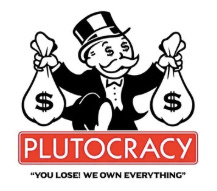
Eat the Rich redbubble.com
In Part 1 of this multi-part Contemplation (see Website Medium Substack) I challenge the belief that governments are benevolent institutions in service of the masses and argue that this is not only a dangerous myth but that they are instead structures of power that arose from exploitation and coercion to serve the interests of a ruling ‘elite’—an undertaking that they continue to perform to this day. I further highlight that the elite depend upon a variety of manipulations to maintain such systems, including controlled redistribution of ‘benefits’ and pervasive narrative management.
In Part 2 (see Website Medium Substack) I expand on this ‘good government’ myth and how governing institutions legitimise themselves. In the modern era this is mostly achieved through the idea that governments shower their citizens with prosperity via perpetual economic growth, while the real intention of this pursuit is to enrich a small number of well-connected people and maintain status quo wealth and power structures. The economic policies implemented by governments are boundlessly marketed as benefitting the masses but their overriding goal is to grow the revenue streams of a powerful and influential minority of the population. While society’s members do receive some ‘benefits’ from growing economic activity, a majority of such benefits are bestowed upon a ‘ruling class’. I explain how this story about good government is part of a historical pattern of justifying myths (e.g., divine right of kings, chain of being, civilising missions) to maintain power and wealth. I finish up this second part by suggesting that the entire modern system is built on a contradictory lie that is becoming more and more difficult to ignore and maintain. As a result, it is likely that the elite will create new narratives to sustain their control, wealth, and prestige as their pursuit of the infinite growth chalice bumps up against biogeophysical limits.
We can already see a number of these new stories emerging…


If you’re new to my writing, check out this overview.
Sustaining Legitimacy On a Finite Planet
There exist a number of ways in which the ruling elite will and are leveraging the challenges of pursuing perpetual economic growth on a finite planet to their benefit so as to sustain their legitimacy and status quo power and wealth structures. The following expands on a number of these, many of which the world is already experiencing to some degree and my belief is that these will continue and grow in form and substance–with the ‘quaint’ notion that the masses have agency in the sociopolitical and socioeconomic realms drifting from view.
Perhaps the most common and historically-utilised means of projecting legitimacy and supporting status quo structures is to identify scapegoats and enemies on which to lay the blame for undelivered prosperity. External enemies manipulating and/or impacting global markets or some other aspect of our world systems, for example, can be blamed for resource shortages rather than biogeophysical limits–a narrative that also serves to increase nationalism, military expenditures, and consolidation of executive power. Alternatively, there’s pointing the finger at internal ‘others’ where some marginalised, domestic groups (e.g., immigrants, welfare recipients) are the cause of societal economic difficulties due to their receipt of benefits unearned and/or unfair to the rest of society–a tale that helps to divide the populace and prevent any type of unified challenge to status quo arrangements. Finally, there’s the anti-growth ‘coalition’ (especially those crazy environmentalists) who can be targeted as the culprit and whose warnings and suggestions/demands are labelled as ‘anti-human’ and even ‘traitorist’, and can be ignored and/or demonised.
Many of the global ruling elite can be seen favouring another means as well: the techno-optimist/green growth stories–which is no surprise given this wealthy group own and control the resources and manufacturing apparatus required to achieve the ‘solution’ to any limits to growth and the various predicaments arising from the pursuit of perpetual growth on a finite planet. This narrative promises that human ingenuity will find ‘solutions’ (e.g., fusion energy, ‘renewables’, artificial intelligence) that do not require any shift in living standards; in fact, they will improve everything and allow for infinite, ‘clean’ growth. This assured future helps to maintain the existing economic order (that enriches the elite) because with salvation always imminent the state can funnel massive subsidies to elite-controlled entities in perpetuity while marketing itself as responsible and forward-thinking.

There’s also the plot twist where, when actual shortages begin to show themselves and lead to social unrest, the state can shift from being the ‘provider’ of perpetual benefits to the ‘manager’ of scarcity. This is an extremely powerful source of legitimacy and one that has been used repeatedly throughout history. During such ‘difficult’ times ‘states of emergency’ are declared, opening the way for the suspension of normal and expected liberties as well as sociopolitical processes where debate is curtailed and dissent viewed as blasphemous. Rationing (e.g., carbon credits, quotas) that is characterised as ‘fair’ will be the order of the day, and this will be framed as necessary and equitable rather than oppressive and intrusive. As for protesting, the building surveillance and security apparatus will be employed to maintain ‘safety’ and ‘order’ where ‘agitators’ will be characterised as criminals and looters that threaten society at a pivotal juncture for the nation.
When technology proves inadequate for the blossoming predicaments, governments may transition to a ‘managed’ decline or ‘austerity’ story–this is often seen after the declaration of war. The state and its propaganda machine (especially the legacy media) will outline the need for ‘coming together’ and ‘sacrifice’ but as the Conflict theory argues this austerity will mostly fall upon the shoulders of the masses rather than the ruling elite. There will be decisions about which regions, industries, and populations to support and which to abandon, with the rationale being of ‘hard but necessary choices’–actions that reinforce the government as the ultimate decision-maker and authority in society.
The growing dilemmas will also witness an increase in performance politics. Here we see grandiose promises (e.g., Net Zero by 2050) being made repeatedly and regularly but that come nowhere near their targets. The blame for the lack of success has been and will continue to be placed upon the citizens for not supporting the sociopolitical systems enough, especially through their lack of voting for the ‘right’ people (i.e., vote harder!). This finger pointing not only directs frustration back towards controlled processes but keeps the growth paradigm itself out of the limelight and free from questioning eyes. It also opens the door for far more authoritarian approaches because the ‘democratic’ ones weren’t effective.
So, while this end of growth is not likely to bring about the end of nation states in the near term it will probably transform them into more overtly authoritarian and managerial in nature. Governing institutions are going to be inclined to centralise their power in the name of ‘emergency management’ where resources become more tightly and directly controlled. Dissent will be increasingly framed as threats to security and stability. And elite privilege will be ensured by use of these tactics.
In summary, governing institutions will morph from being ‘abundance providers’ to ‘chaos protectors’ whereby their legitimacy will be centred around a story that shows them as the sole thing standing between society and mass chaos and disorder. And there is also a good argument to be made, based upon past experience and evidence, that the elite will not be hesitant to take nations to war in their attempt to sustain their control and status quo structures in their nations. Further, I wouldn’t be surprised to see marginal/minor disagreements/conflicts with long-time geopolitical foes–and even allies–grow, especially if they have a strong resource base.

Economic Machinations
Given the current zeitgeist that governments legtimise themselves via (i.e., perpetual economic growth), what future manipulations are we likely to experience in the economic realm?
Credit-money creation and resource extraction tend to be the two most important factors in perpetuating current economic growth. And this may be the core of our entire modern dilemma for these two aspects are on a direct collision course with existence on a finite planet.
Resource Extraction
In order to keep the growth-based system of modernity functioning, we are likely to witness a significant increase in resource extraction, especially as it pertains to our master resource: hydrocarbons, particularly oil–and this is in addition to the resource decline dynamics that accompany extraction of finite materials/minerals.
We have already passed the peak of ‘easy oil’, the oil that is most accessible and of the highest quality. This undeniable fact has necessitated a transition to reserves that are more: difficult to attain, energy-intensive, and ecologically destructive (e.g., tar sands, deep-water, shale). The result is an ever-increasing loss of net energy and the need to extract faster and faster to simply meet current demands; and then there is growing demand to consider.
We can already see the next leg of this journey in an intensification of ‘last-minute plunder’ (e.g., “drill, baby, drill”) in order to maintain elite revenue streams. We are witnessing fragile frontiers being increasingly pushed into and their exploitation framed as necessary for ‘national security/interest’ and to counter economic headwinds (e.g., impact of tariffs). In the wake of this, environmental regulations are being dismantled due to their excessive stifling of ‘progress’ and the need to achieve energy ‘independence’. This will continue and expand.

The militarisation of resource scarcity is also imminent via increasing geopolitical conflict and war, but will be framed as anything but control of/access to resources. The resulting international tension will grow as diminishing returns on extractions continues to bite. The narratives about all of this will be sure to be about ‘external enemies’ who are threatening the homeland in one form or another.
And, finally, there’s the paradox of ‘green energy’ extraction. ‘Renewables’ do not in any way, shape, or form transition the world away from our massively ecologically-destructive resource extraction processes; in fact, they do quite the opposite. But as we can see with the stories told about this supposed ‘transition’, it will continue to be justified and legitimised in the name of ‘clean’ energy, climate ‘action’, and human ingenuity ‘solving’ our ‘problems’–with the obvious destruction hidden/ignored/denied.
Unfortunately, this ramped-up extraction will become evermore destructive, expensive, and lead to greater geopolitical stress and conflict. The benefits to society as a whole, however, will continue to diminish while likely resulting in ever-greater wealth inequality as the owners of the resources and various industries see increasing profits.

Credit-Money Creation
Our financial systems are already facing concerns about their legitimacy and value. While most acknowledge that money is a claim on future goods and services, they miss perhaps the most important facet of this: these claims are very much predicated on future resource extraction, particularly energy. In a world constrained by biogeophysical limits, these claims become more and more tenuous in nature.
One of the more important aspects to consider is the inflation/deflation trap whereby essential commodities (e.g., food, energy) experience perpetual rising costs in concert with more costly resource extraction, leading to a permanent decrease in living standards for most everyone. A lot of this has been offset for the past few decades by the massive growth of credit/debt.
But with an ever-larger debt burden due to decades of debt creation to support growth, increasing numbers of businesses and individuals are defaulting on their borrowing causing decreasing demand and asset price deflation–the killer of a system reliant upon perpetual growth. This situation ‘traps’ central banks and the state since raising interest rates to counter inflation tends to trigger a deflationary debt collapse. And we can already see a shift in recent trends with central banks moving back towards a monetisation of debt via the lowering of interest rates and ‘printing’ of money in an attempt to keep the financial system solvent.

This approach by the central banks is a weaponisation of financial repression. They will in all likelihood combine an attempt to manipulate interest rates lower to release some of the building pressure along with direct funding to devalue the debt itself. This is a stealth bailout of debtors (i.e., corporations, the state) on the backs of creditors (i.e., pensioners, savers) but marketed as necessary economic stabilisation. Their previous ‘concern’ about keeping inflation low will be softened with increased manipulation of headline inflation statistics, greater acceptance of higher inflation rates, and hardened finger pointing at ‘uncontrollable’ factors causing increased prices. The end result will be a massive transfer of wealth from the masses to the elite.
I have little doubt that system-critical corporations (e.g., financial institutions, oil and gas companies) will be bailed out by the state as conditions worsen. The masses, however, will experience the impact of a fiat currency losing its purchasing power with each and every day. Living standards for most will fall, dramatically. We may even see the global rollout of central bank digital currencies (CBDCs) as some are foretelling since these could be a significant control mechanism as things go sideways. CBDCs can be used that have a ‘best before’ component–such as negative interest rates to discourage saving–and control where and how money is spent via restrictions on ‘unapproved’ activities and products.
Managed Triage
It seems likely, from a self-preservation perspective, that the ruling elite will do all they can and for as long as they can to extend the current systems. They will pursue an intensification of resource extraction and financial repression in their attempts to ‘manage’ the inevitable ‘collapse’ of our unsustainable complex societies.

Our ‘good governments’ will in all likelihood take it upon themselves to direct credit and capital with a strong hand (yes, authoritarian if you will) towards critical sectors while funnelling it away from those deemed non-essential. And you can be assured that they will frame this as necessary and beneficial for everyone. But what is considered necessary to the ruling elite tends to be quite different from what the masses hold as essential, and the benefits are sure to be quite disproportionate between the ‘haves’ and ‘have nots’.
Funding for hydrocarbon and important mineral/material extraction, along with the military-security complex, will be a priority. Alongside this will be support for ‘bread and circuses’ to pacify the masses. In particular, we may see a dramatic extension of income and food subsidies (the bread) along with support for the digital sphere and other forms of ‘entertainment/distraction’ (the circuses).
Whether or not the ‘elite’ actually engage in war with a geopolitical competitor or one against climate change in order to justify/rationalise their actions, they will most certainly use the narrative of requiring a ‘wartime economy’ in which there exist strict financial controls and sacrifice from ‘everyone’ via the curtailment of certain ‘freedoms’ and ‘luxuries’ in order to ‘survive’. We could also see the formalisation of inequality where the ruling elite and their retainer class exist in high-consumption and -tech enclaves while the majority are transitioned towards ‘managed’ austerity.
The ‘hope’, then, is to not experience a sudden ‘collapse’ but a controlled and extended ‘descent’. Credit-money creation is likely to continue for some time along with resource extraction but they will be wielded with increasing state force in order to maintain its power and legitimacy. This will occur in a world with an increasingly shrinking material pie where the ruling elite narrative shifts from the delivery of prosperity to one of managing scarcity for the benefit of all.
Conclusion
Humans tell stories for a variety of reasons. To help make sense of the world. To communicate knowledge to others. And to manipulate the beliefs and actions of others.
With respect to the ones told by our ruling elite regarding ‘good government’, the masses tend to believe them due to the human propensity to defer to authority. But also to reduce cognitive dissonance. For if the world’s citizens were to acknowledge the argument that our governments primarily serve the interests of a select few and that we have ceded power and control (although that implies agency we likely don’t have) for reasons other than what they tell us repeatedly, then most might be overwhelmed with discomfort, anxiety, and grief. So the vast majority would much rather believe a false narrative than experience such emotional distress.

linkedin.com (Rebecca Johnson)
The evidence above strongly suggests that our sociopolitical systems have ‘evolved’ into institutions that primarily serve the interests of the ruling ‘elite’ and in particular their maintenance and control of the wealth-generation/-extraction systems that provide their revenue streams and thus positions of power and prestige.
Yes, there are some collective ‘goods’ that arise from these systems, and to be sure those benefitting most from these systems highlight repeatedly these collective ‘goods’. And they also stress that these would not be possible without their beneficent policies and actions. But in keeping with the evidence, it would appear that ‘forfeiting’ a percentage of a society’s surpluses is merely the ‘price to pay’ to ensure the status quo power and wealth structures that benefit those that reside at the top of these structures remain in place and the masses do not revolt (as tends to happen when a society’s wealth disparities become overly large).
When one understands the above and that the fundamental base of today’s wealth is predicated upon the various wealth-generation/-extraction systems being maintained via economic growth, it is completely understandable why such growth is pushed and pursued by our governing institutions. Without this growth, the entire foundation of today’s ruling elite’s revenue streams and thus privileges crumbles.
What’s perhaps most important to keep in mind going forward is that the machinations to keep the power and wealth structures of a society in place will enlarge as we travel along the downslope of contraction brought about by the limits of the biogeophysical systems that support these structures. The elite will in all likelihood protect their portion of the economic pie by whatever means necessary.
Regardless of the consequences of such growth (immediate and/or long term), it will be pursued. Evidence and/or narratives that challenge this pursuit will be ignored, denied, ostracised, vilified, perhaps even made illegal (e.g., see this where anti-capitalism is among a litany of ‘violent’ attitudes that can get you put on a watchlist for potential domestic terrorism in the U.S.).
Once you begin viewing the world through the lens created by the discussion above, you can see the origin, maintenance, workings, and motivation of state governing institutions in a significantly different way. One that stands in stark contrast–perhaps even diametrically opposed–to the perspective painted by these institutions themselves and those that benefit from the power and wealth structures that arise from status quo sociopolitical and socioeconomic systems.
Mister Rate: The world aint’ what it seems, is it gunny?

Movie clip Shooter (2007) Paramount & Di Bonaventura Pictures
As humanity lurches ever-forward towards a reckoning with the consequences of their ecological overshoot predicament, its various symptom predicaments, and a variety of problems (due mostly to increasing complexity and investments in these experiencing diminishing returns), the prospects for humanity being ‘saved’ by institutions that serve a ruling elite are dim. In fact, it may not be hyperbole to state that such a prospect is non-existent.
‘Control’ of the globe’s socioeconomic and sociopolitical policies and actions are in the hands of individuals, families, and various well-connected/influential interest groups who have discovered that their revenue streams, power/clout, and/or prestige can best be maintained through the pursuit of perpetual economic growth. This is their primary motivation: continue to chase the infinite growth chalice and divert a good portion of the resulting ‘wealth’ to friends, family, and influential supporters. Everything else is secondary and tertiary.
The rest of the world’s population doesn’t matter (except perhaps as tax donkeys and labourers). The destruction of the globe’s ecological systems doesn’t matter (except when it impacts profits). Other species don’t matter (only humans do, especially the ruling elite). Little else matters–except where it can be leveraged to create additional revenue streams and profit.
Continuing to believe such institutions and their ‘representatives’ serve the interests of the masses rather than the ruling elite is misguided, to say the least–especially as we bump up against the biogeophysical limits of a finite planet and humanity’s economy begins to contract. It is believing in a myth perpetuated to maintain status quo power and wealth structures but marketed to all as having been created as a ‘service’ to everyone and must be supported.
We will experience the stories about why we must support these systems shift, particularly as our economic and political worlds change in response to growth limits and the multitude of negative consequences that arise from having pursued it for so long and so destructively.
The evidence demonstrates that not only have these institutions come into existence via coercion and exploitation, but that the maintenance of the systems that perpetuate current power and wealth structures requires activities and complexities that are exacerbating our predicaments and creating all sorts of additional problems and evermore complexity. A recipe that, in the longer run, serves no one’s interests but is being chased nonetheless while being marketed as THE solution to the problems and predicaments that have arisen as a result of pursuing it.
A few recent and relevant posts:
The Great Debasement: Why Currencies Keep Losing Value
America’s Sixth Default Is Coming—What It Means for Gold and Your Wealth
The Trump Tariff and Stock Market Scam
The U.S. Quietly Bails Out Its Banks
Shit Is Breaking..And It Will Get Worse
Gain-of-Function Monetary Policy – by Eric Salzman
Visualizing Global Wealth Inequality in 2025
American Oligarchs: The Media Consolidation Timeline
The American Augean Stables — How Corruption Has Amended the Constitution
What Does an Economy Without Growth Look Like?
Tanzania Faces Mounting Political Repression Ahead Of Elections
The Bezzel: Is it 1925 All Over Again? – The Daily Reckoning
ZIRP or ZAP? Will the Fed’s ‘Zero-Interest Rate Policy’ Return, and Will It Work?
2035: Permanent Crisis – The World After American Unraveling | Collapse of Industrial Civilization
What Comes After the Current Financial System Ends?
What does the government know?
The Fed’s Pivot: The Return of Easy Money and the Inflation Storm Ahead
What is going to be my standard WARNING/ADVICE going forward and that I have reiterated in various ways before this:
“Only time will tell how this all unfolds but there’s nothing wrong with preparing for the worst by ‘collapsing now to avoid the rush’ and pursuing self-sufficiency. By this I mean removing as many dependencies on the Matrix as is possible and making do, locally. And if one can do this without negative impacts upon our fragile ecosystems or do so while creating more resilient ecosystems, all the better.
Building community (maybe even just household) resilience to as high a level as possible seems prudent given the uncertainties of an unpredictable future. There’s no guarantee it will ensure ‘recovery’ after a significant societal stressor/shock but it should increase the probability of it and that, perhaps, is all we can ‘hope’ for from its pursuit.”
If you have arrived here and get something out of my writing, please consider ordering the trilogy of my ‘fictional’ novel series, Olduvai (PDF files; only $9.99 Canadian), via my website or the link below — the ‘profits’ of which help me to keep my internet presence alive and first book available in print (and is available via various online retailers).
Attempting a new payment system as I am contemplating shutting down my site in the future (given the ever-increasing costs to keep it running).
If you are interested in purchasing any of the 3 books individually or the trilogy, please try the link below indicating which book(s) you are purchasing.
Costs (Canadian dollars):
Book 1: $2.99
Book 2: $3.89
Book 3: $3.89
Trilogy: $9.99
Feel free to throw in a ‘tip’ on top of the base cost if you wish; perhaps by paying in U.S. dollars instead of Canadian. Every few cents/dollars helps…
https://paypal.me/olduvaitrilogy?country.x=CA&locale.x=en_US
If you do not hear from me within 48 hours or you are having trouble with the system, please email me: olduvaitrilogy@gmail.com.
You can also find a variety of resources, particularly my summary notes for a handful of texts, especially William Catton’s Overshoot and Joseph Tainter’s Collapse of Complex Societies: see here.