Today’s Contemplation: Collapse Cometh CCXXVIII–
We’re Saved! Steel Production Without Coal.
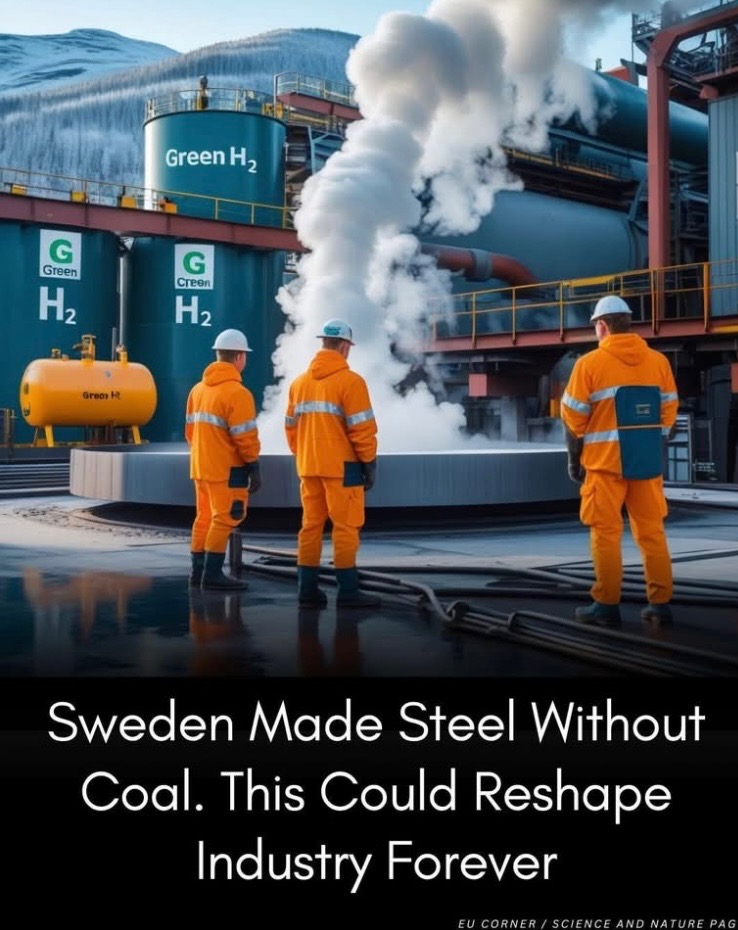
Techno-optimist’s claims are relentless. One that has come across one of my social media feeds a few times is the tale that Sweden is now producing steel without the use of coal, a process that “could reshape the industry forever”.
And, yes, the declaration that Sweden has made steel ‘without coal’ is, on the surface, true. A pilot project has been successful in producing a relatively small amount of steel using hydrogen-based energy from ‘renewable’ sources and delivered it for industrial use to Volvo Cars (see: this and this). The claimed benefits of this production methodology are plentiful according to both the marketers and supporters of this process who are, not surprisingly, primarily those who profit from this narrative. Let’s pull back the curtain a bit and explore this ‘world-changing’ technology and its myriad of beneficial attributes.
RMI, a ‘clean energy’ advocacy organisation, argues that because steel making with the use of coal is a major carbon emitter (estimated at 7-9% of global emissions), it’s of utmost importance to implement decarbonising strategies and processes for steel making on a global scale (see: this). The strategy to do this put forward by RMI is that steel production can be ‘decarbonised’ through the use of hydrogen-based, ‘carbon-free’ energy, with the energised hydrogen being produced via ‘renewable energy’ technologies, particularly hydroelectric- and wind-based power generation.
The benefits highlighted by RMI include those in both the environmental and economic arenas. The main benefit focussed upon is a reduction of carbon emissions to near zero, with the only byproduct being water vapour.
According to RMI the economic benefits for Sweden of pursuing this technology are massive. Although there would be significant upfront costs, the argument goes that increasing market demand and a willingness to pay a premium for ‘green’ steel ensures future profitability. And the implementation of carbon-pricing regulations will make traditional steel production more expensive, helping to make ‘green’ production more attractive since it avoids such carbon penalties. Having low-cost hydro and wind generation further benefits Sweden, making the production of ‘green’ hydrogen possible and profitable.
On a longer-term basis, Sweden benefits economically through the massive economic growth such a transition stimulates and the billions of dollars in investment likely to flow to the leaders in this new and unique industry.
At least two wonderful selling points: ‘Clean, sustainable, and carbon-free’ steel production, along with massive economic growth.
What’s not to love?
Well…

If you’re new to my writing, check out this overview.
When it comes to such bold claims, it’s wise to scratch a little at the surface to get a glimpse of the reality upon which such assertions are made. A closer examination reveals a narrative built upon a very narrow definition of ‘green’, thermodynamic ignorance, and a gross failure to confront the limits of scale and growth.
Green Steel’s Clean and Carbon-Free Energy Production
As for RMI’s claims above regarding the decarbonisation of steel production via hydrogen-based energy, this is a patently false claim–as I argue in my Contemplation on hydrogen-based energy systems (see: Website Medium Substack). Simply stated, hydrogen-based energy requires massive hydrocarbon inputs. From its ‘renewable-energy’ infrastructure to the hydrogen-production facilities, extremely significant hydrocarbon-based industrial processes are required to procure ‘carbon-free’ energy.
When one only focuses upon the end-user byproduct of water vapour for the generation of hydrogen-based energy systems, then it is entirely possible to claim that this energy is ‘clean’. But this is disingenuous since it ignores so much of what goes on to create this energy, to say little about the fact that the byproduct (water vapour) is the most significant greenhouse gas serving to amplify the greenhouse effect (see: this, this, and this). To only include the end-use aspects in forming a declaration of ‘cleanliness’ is misleading in the extreme in that it ignores all the ecologically-destructive processes and industries necessary to produce the energy.
The energy source ‘green’ steel uses is not ‘carbon free’. Given that this tends to be the guiding light for what technologies are considered ‘clean’ or not, it is also thus not ‘clean’. So, right from the get go the contention that ‘green’ steel is ‘clean’ is patently false. The error of these assertions, however, go much deeper as I will demonstrate.
Hydrogen-Based Energy’s Other Drawbacks
As I highlight in my Contemplation on hydrogen-based energy systems, this energy system results in a net energy loss. In other words, more energy is required to produce the energised hydrogen than it delivers for use. So, any ‘green’ steel production is operating at an energy loss. And while this may be fine for small-scale test runs whose chief goal is to demonstrate the feasibility of the technical process, attempts to scale this up would result in massive energy losses. This is neither economically nor thermodynamically sustainable.
‘Green hydrogen’ also requires a dedicated and massive infrastructure. Energy production in the form of ‘renewables’. Storage. Transportation. Distribution. All of these aspects need to be newly constructed, managed, and maintained.
There are also significant safety and technical hurdles to confront. From the highly flammable and difficult-to-contain properties to the material embrittlement concerns. In addition, specialised, complex, and very expensive engineering and safety protocols are required.
Finally, there is the argument that the production and use of hydrogen-based energy systems add to our fundamental issue of exacerbating the negative consequences of pursuing business-as-usual economic growth. Rather than pursuing demand reduction, degrowth, and resilience-building within ecological limits, techno-fixes like ‘green’ steel production using ‘green hydrogen’ attempts to sustain the unsustainable.
Even if these thermodynamic and safety hurdles were disregarded, the project of scaling ‘green’ steel up to meet global demand faces insurmountable practical barriers.
Other Relevant Hurdles
While Sweden’s pilot proves technical feasibility, there exist some rather significant hurdles for ‘green’ steel to ever reach commercial success.
Scale
The implementation and scaling up of such an industry faces complex and relatively time-consuming and slow permitting that will delay any massive build out. It has been estimated that just for Sweden, full-scale production could increase electricity demand by 50% or more leading to a bottleneck in any attempt to secure ‘green’ energy sources (see this). This energy demand would also likely lead to tension over access to current energy, and perhaps lead to significant price increases for all users.
It is estimated that ‘decarbonising’ all iron production through the ‘green’ steel technology being discussed would require 2,700 TWh of ‘renewable’ electricity per year. This is equivalent to the total annual electricity demand of the entire European Union (see: this). To put this energy need in perspective, the planet uses about 1.8 billion tonnes of steel per year (while production has tripled over the past fifty years, the last 4 have held steady). As for ‘green’ steel produced by Sweden, it currently produces no ‘green’ steel but is hoping that before 2030 to produce about 2.5 million tonnes per year–just slightly less than 0.14% of the global total.
Economics
‘Green’ steel production currently costs about 20-30% more than that produced via traditional, coal-based technologies. According to economic projections, ‘green’ steel only becomes competitive where and when carbon-pricing regulations are present. There are also significant upfront costs that must be secured via investments in the billions of dollars, and this is already impacting construction plans significantly. And although the marketers and advocates suggest customers will pay a premium for ‘green’ steel, there are no guarantees of this. ‘Build it and they will come’ is not a sound economic plan, but one that is often offered by those pushing such technologies–with projected costs almost always exceeding estimates and benefits rarely, if ever, meeting expectations.
Technical and Operational
There are some projects that are being rushed in an attempt to achieve full-scale production (see this), but given the lack of experience this increases the risk of making errors. This is particularly so because the technology is relatively new with unforeseen challenges and complexities. Success also depends very much on a parallel build out of ‘green’ hydrogen infrastructure, including ‘renewable’ energy and grid capacity.
Sweden’s rushed commercial facilities have already run into construction delays and ever-rising costs. They are hoping to begin steel production within the next two years, but there are no guarantees.
Conclusion
The promises made by ‘green’ steel’s advocates collapse under the weight of the evidence. It is not only not ‘green’–given the hydrocarbon-intensive infrastructure required–but it is also a non-solution, impossible to scale up for even a fraction of global demand. Thus, the celebration of ‘coal-free’ steel stands as a classic example of techno-optimist overreach.
While the pilot project proves technical feasibility, the surrounding hype serves as a dangerous distraction from the necessary discussions about growth-oriented overconsumption. Such techno-fixes ultimately strive to sustain the unsustainable.
In light of the non-green lifecycle, the negative energy balance, and its fantastical scaling requirements, ‘green’ steel reveals itself not as a path to sustainability, but as a proposal to swap one set of resource-intensive inputs for another. True sustainability will not be found in such substitutions–if it can be found at all–but in questioning the growth-oriented consumption they are designed to perpetuate.
What is going to be my standard WARNING/ADVICE going forward and that I have reiterated in various ways before this:
“Only time will tell how this all unfolds but there’s nothing wrong with preparing for the worst by ‘collapsing now to avoid the rush’ and pursuing self-sufficiency. By this I mean removing as many dependencies on the Matrix as is possible and making do, locally. And if one can do this without negative impacts upon our fragile ecosystems or do so while creating more resilient ecosystems, all the better. Building community (maybe even just household) resilience to as high a level as possible seems prudent given the uncertainties of an unpredictable future. There’s no guarantee it will ensure ‘recovery’ after a significant societal stressor/shock but it should increase the probability of it and that, perhaps, is all we can ‘hope’ for from its pursuit.”
If you have arrived here and get something out of my writing, please consider ordering the trilogy of my ‘fictional’ novel series, Olduvai (PDF files; only $9.99 Canadian), via my website or the link below — the ‘profits’ of which help me to keep my internet presence alive and first book available in print (and is available via various online retailers).
Attempting a new payment system as I am contemplating shutting down my site in the future (given the ever-increasing costs to keep it running).
If you are interested in purchasing any of the 3 books individually or the trilogy, please try the link below indicating which book(s) you are purchasing.
Costs (Canadian dollars): Book 1: $2.99; Book 2: $3.89; Book 3: $3.89
Trilogy: $9.99
Feel free to throw in a ‘tip’ on top of the base cost if you wish; perhaps by paying in U.S. dollars instead of Canadian. Every few cents/dollars helps… https://paypal.me/olduvaitrilogy?country.x=CA&locale.x=en_US
If you do not hear from me within 48 hours or you are having trouble with the system, please email me: olduvaitrilogy@gmail.com.
You can also find a variety of resources, particularly my summary notes for a handful of texts, especially William Catton’s Overshoot and Joseph Tainter’s Collapse of Complex Societies: see here.
[…] my previous We’re Saved! Contemplation (see: Website Medium Substack)–another in my series that has attempted to pull the curtain aside on […]