Today’s Contemplation: Collapse Cometh CCXXIV–
We’re Saved! Thorium-Fuelled and Molten Salt Reactors.
There always seems to be an acceptance-pushback response (e.g., “Yeah, but…” ) by someone when I raise the alarm about a trumpeted energy ‘solution’ that is making legacy media headlines and/or the rounds on social media–then is invariably overhyped by a click-bait site seeking to generate revenue through more eyes–and becomes amplified by those who trust what they’re being repeatedly exposed to and have not cared to look critically into the claims being made.
And, more often than not, when I have been critical of nuclear energy, these are “but…fusion”, “but…small modular reactors (SMRs)”, “but…thorium”, or “but…molten salt reactors”. I’ve already expanded on a critique of nuclear fusion reactors and addressed SMRs in my series on the supposed Nuclear Renaissance. This Contemplation focuses upon thorium-fuelled and molten salt reactors (MSRs).
I will begin with an overview of the history and basic engineering of such reactors, followed by a focus on the significant hurdles and issues facing this latest, greatest ‘solution’ to creating sustainable, clean energy. Many of the impediments facing thorium and molten salt reactors are identical to those of fusion reactors but believers will be believers regardless of evidence that contradicts their enthusiasm and ‘hope’.
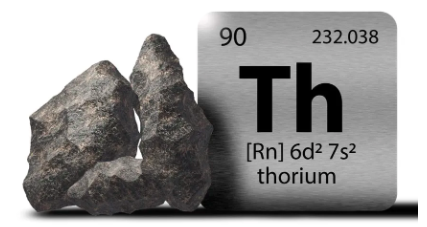 Thorium and Molten Salt Reactors
Current Praise
Thorium-fuelled nuclear reactors receive a lot of kudos from the industry (who just happens to be profitting from any increased investments in such technology) and media (who tend to parrot uncritically the industry marketing/propaganda; which might have something to do with the infinite growth story it supports and the advertisement revenue garnered from this mythological narrative). The primary talking point for such cheerleading is that they offer a number of ‘potential advantages’ over current uranium-based systems. Proponents argue this energy is needed to not only power economic growth but expand sectors like Artificial Intelligence and data centres; this argument, however, operates within a perpetual growth paradigm that does not account for the biogeophysical limits that exist on a finite planet.
According to nuclear energy advocates, the benefits of thorium-fuelled reactors include: a more abundant fuel source with thorium being about 3 to 4 times more bountiful in the planet’s crust than uranium; the ability to ‘breed’ uranium within certain reactor types, providing more fissile material than is consumed; supposedly being ‘safer’ than traditional reactors–Molten Salt Reactors (MSRs), for example, can have their reaction stopped relatively easily via its liquid fuel being drained–and they produce less long-lived high-level radioactive waste; and, as the U-233 produced is extremely highly radioactive, it is much more difficult to handle and proliferate illicitly.
Early Promise
While the concept of thorium-fuelled reactors (like fusion ones) is thought by many to be a relatively novel one, the reality is that research surrounding such reactors to provide safe, sustainable, and efficient carbon-free energy has been with humanity since the beginning of the atomic age–some 75+ years. (Note that the history of thorium-fuelled reactors is somewhat parallel to that of MSRs since MSRs are well-suited to using thorium as a fuel.)
In the early 1940s, nuclear chemist Glenn Seaborg discovered how to use thorium-232 (Th-232) to breed uranium-233 (U-233) via neutron bombardment in a cyclotron. Shortly afterwards, during the Manhattan Project, he realised the potential of this uranium as a fissile material and proposed that Th-232 and U-233 could be used in thermal-breeder reactors. While his research on this aspect of nuclear chemistry continued, it was largely shelved by administrators of the project in favour of a focus on plutonium, which he had also discovered.

If you’re new to my writing, check out this overview.
Experimentation
After the Second World War, reactor experimentation expanded using different fuels and reactor designs. Some reactors used a thorium-uranium mix, others tried plutonium fluoride, and still others used solely uranium.
Of particular interest to thorium fuel use were the Aircraft Reactor Experiment (ARE) in the 1950s and the Molten Salt Reactor Experiment (MSRE) during the 1960s; both carried out at the Oak Ridge National Laboratory in the United States. The ARE was the first MSR to operate successfully (for 9 days), demonstrating the feasibility of the design. This led to the MSRE which used U-233 bred from thorium to show that a liquid-fuelled reactor was possible.
Additional research in both the US and Europe used thorium-based solid fuels to test its viability for reactors. Most notably, the US’s Shippingport Atomic Power Station exhibited a ‘breeding gain’ during the 1970s whereby U-233 fissile material bred from Th-232 increased slightly during the process–in other words, more material was produced than was consumed.
Faltering Economic and Political Support
Despite the success of thorium-fuelled and molten salt reactors, the 1970s witnessed the US Atomic Energy Commission (AEC) opting to push and build out a fleet of solid, uranium-fuelled reactors. They argued that the uranium reactors were more efficient, and that thorium’s breeding ratio could not support a scaled-up number of reactors. The decision was likely also influenced by the fact that the industry had already invested heavily in uranium-fuelled, light water reactors, and transitioning to a thorium fuel cycle requiring a different infrastructure would be extremely costly. This decision greatly slowed the exploration and use of thorium-based reactors. [Note: some have suggested that the uranium-breeding reactors were preferred due to the weapons grade plutonium that could be produced via them.]
Resurgence and Renewal
Since the 1990s there has occurred a resurgence in interest in thorium-fuelled reactors alongside research on novel reactor designs and molten salts. The enthusiasm for these thorium-fuelled, molten salt reactors has been building; in fact, molten salts were formally recommended to be the basis of Generation IV reactors in 2002. For more than twenty years now, the focus for the nuclear industry has been to get such reactors and the massive research surrounding them funded. They have flooded the media with potential benefits and highlighted ‘breakthroughs’ on a regular basis in order to attract evermore investment, and “keep the dream alive”.
Academic and private research/experimentation surrounding these thorium-fuelled, molten salt reactors and new reactor designs continues. In Norway, thorium-bearing fuel rods have been tested in conventional reactors. More recently, China has claimed criticality and full operational success with an experimental MSR; and India has experimented with a Prototype Fast Breeder Reactor (PFBR) and Advanced Heavy Water Reactor (AHWR). The industry is proclaiming that pre-commercial prototypes demonstrate the need for further investment to fund advanced research (to overcome specific ‘challenges’) and eventual construction. Any. Moment. Now.
A clean, sustainable, and safe option to uranium-fuelled nuclear reactors. What’s not to like?
Well…
 (stock.adobe.com)
Despite the much ballyhooed benefits outlined above, there exist a variety of not insignificant hurdles to the mass build out of thorium-fuelled nuclear reactors. These are technical and physical in nature, but also economic and political–thus the need for massive lobbying and marketing/propaganda to help build investment funding and political and social capital. But before getting into these impediments in greater detail let’s have a brief reality check on some of the more common claims by the advocates of these reactors and their fuel.
Common Claims Critique
The argument that these reactors are inherently safer is not due to the fuel source but due to some engineering changes. But even given this, without proven commercial reactors working at scale the claim is, at best, based on faith/hope that new designs and their safety protocols will work as projected.
The assertion that thorium-fuelled power generation will be more economical because there exists abundant fuel is also in question. In fact, this is considered false by many. A traditional uranium-fuelled reactor’s fuel costs are a relatively small percentage of operating budgets; most costs are due to the upfront funding of constructing the reactor (which are considerable, and almost always well beyond initial projected budgets). Using thorium fuel does not reduce costs and may actually result in higher costs given the need to create a whole new fuel cycle infrastructure from scratch.
Additionally, the idea that thorium waste is easier to manage than uranium is patently false. While thorium-based fuel has a radioactivity similar to uranium for the first 100 years of its existence, it will actually be much higher after 100,000 years. This suggests such waste must be properly controlled and managed much, much longer than uranium-fuelled reactor waste–neither of which, of course, are going to be for the length of time needed if we’re being honest (more on this later).
Specific Hurdles To Overcome
Complex Material Science and Engineering
Thorium is not fissile in that it cannot sustain a chain reaction and requires a ‘driver’ fuel that can start and maintain the reaction process. It must have fissile U-235 or plutonium present for this. This causes the fuel cycle to be more complex, and thus more costly, than traditional reactors.
Th-232 is converted to U-233 through absorption of a neutron within the reactor. And to breed new fuel ‘efficiently’, spent fuel must be processed to remove neutron-absorbing fission products and extract the U-233; all of which requires the development and operation of an expensive, heavily-shielded, and complex chemical processing plant that is constructed with materials that can withstand high-level radiation. Such molten salt reprocessing technology has yet to be proven at a commercial scale.
MSRs require highly corrosive fluoride or chloride salts that must be kept at extremely high temperatures (about 700°C). Because of such temperatures, a major challenge then becomes finding and creating material that can withstand high temperatures and not corrode for very long periods (i.e., decades). And, as recently as 2018, a US study of the corrosion issue concluded that this was perhaps the most problematic hurdle keeping MSRs from being viable at a commercial level. They had yet to find any material that would work.
The breeder fuel (U-233) tends to be contaminated with U-232 that contains high-level radioactive decay isotopes (e.g., thallium-208) that produce gamma radiation making fuel fabrication, reprocessing, and transportation extremely hazardous and quite difficult. As a result, heavy shielding and remote handling is required, and which further increases the costs.
Regardless of the decades-long knowledge of such reactors and research surrounding them, the technology remains relatively immature in its development–a number of the ‘solutions’ being proposed to address such issues remain ‘theoretical’ in nature. There is also a lack of commercial-scale experience having had past experiments discontinued.
Economics
Relative to established alternatives, thorium-fuelled reactors are quite expensive (not less as is often argued). They have extremely high upfront capital, research, and development costs. Significant long-term investment is required to fund: the creation of new designs; attempts to ‘solve’ the engineering and material issues; construction of experimental/prototype reactors; and, establish needed infrastructure for supply chains.
Entrenched uranium-fuelled reactors are extremely cheap in comparison, especially given established fuel supply chains. Until and unless the price of uranium increases substantially, the expensive and complex reprocessing of thorium is unjustifiable. Of course, the industry argues that significant investment is needed to address such issues and bring down the costs. A further argument in favour of addressing the prohibitive costs is to build thorium-fuelled Small Modular Reactors where factory fabrication of components can reduce budgets; of course, this is only after they are built out into the hundreds of such reactors. So, build them and the costs will ‘eventually’ come down is the ‘promise’ by the industry–and that has always worked out according to plan; except I seem to recall a promise about electricity being ‘too cheap to meter’ when nuclear power generation was in its infancy and seeking support.
In addition, there exists uncertainty regarding timelines, costs, and financial risk given the absence of regulatory frameworks for thorium-fuelled and molten salt reactors. What appears to be happening in light of this, however, is a lobbying push by the industry to expedite such processes by reducing/removing regulations so as to reduce the risk for investors (thus attracting capital). Critics argue this is highly ‘problematic’ in that by rushing such approvals through the likelihood of overlooked issues increases substantially, placing not only the immediate environment at risk but the entire biosphere.
Politics
There exist some not insignificant political considerations and hurdles to an expansion of nuclear reactors in general, with some of these specific to thorium-fuelled ones.
The proliferation of nuclear weaponry is one of those. While thorium is heralded as ‘proliferation-resistant’ (i.e., the U-233 produced from it contains high-level gamma radiation making it extremely difficult to handle safely), a determined nefarious actor could overcome this.
In addition, the sunk costs for the current global fleet of uranium-fuelled reactors and its infrastructure are enormous. It is financially prohibitive in the extreme to try and duplicate and/or replace this–and this may be especially so in a world ‘drowning in debt’ and already bumping up against material and mineral ‘resource limits’ in a number of areas. [Note: the marketing/propaganda by the industry and sociopolitical system, however, is trying desperately to underplay/ignore these impediments by spinning their buildout as economically beneficial, massive job creators, and necessary for the ‘guaranteed’ and ‘inevitable’ economic growth on the horizon.]
There also exists significant competition within the nuclear industry itself for investment funding. Next-generation uranium-fuelled reactors (especially Small Modular Reactors) and refurbishment of many reactors within the current fleet are competing for financial support. Despite what appears as self-evident limits to expansion, the nuclear industry and sociopolitical systems seem to be advocating for all iterations, including thorium-fuelled SMRs.
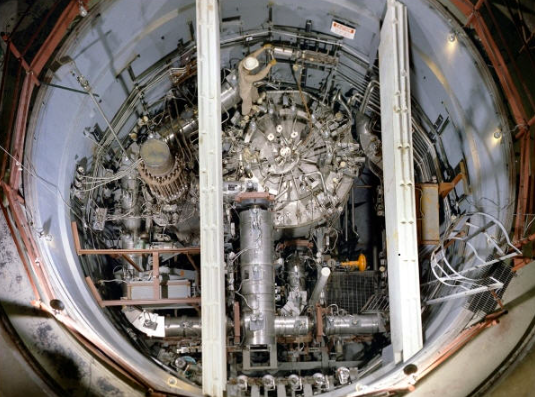
Early thorium-based (MSR) nuclear reactor at Oak Ridge National Laboratory in the 1960s.
A Cautionary Tale
The MSRE carried out at the Oak Ridge National Laboratory in the 1960s is often referenced as successful by optimists as it is considered the foundational example upon which molten salt reactor hopes are placed. The operational record of this experiment, however, demonstrates ongoing and persistent issues that should, but don’t, temper enthusiasm.
The MSRE experienced some 225 unplanned shutdowns over its four years of operation due to various technical failures, with only 58 of these being planned–the vast majority caught the operators completely by surprise. In addition, the reactor failed to ever reach its projected power generation, experienced ongoing component failures (e.g., blower and electrical system), pipe plugging, and fuel leaks despite safety systems meant to prevent such leakages.
Some Further ‘Small’ Considerations To Ponder
As-Yet-To-Hatch-Chickens
The enthusiasm displayed for thorium-fuelled reactors, especially of the molten salt breed, continues to be based quite substantially upon theoretical potential as opposed to repeated and confirmed evidence–particularly at a commercial scale. The technical hurdles for the fuel cycle (e.g., requires continuous chemical processing), reactor component longevity due to corrosive molten salts, and extremely high-level radioactive byproducts remain.
Politics
Sociopolitically, a novel regulatory framework is required to be created given the uniqueness of the reactor designs and fuel cycles. And the push by the industry to minimise such regulations (with accidents still in most people’s minds and accumulating waste piling up at nuclear plant sites) is raising substantially the concerns amongst a growing number of people.
Being ‘Green’
The idea that this technology (or any nuclear-powered one) is ‘green/clean’ must be challenged given the long-lived radioactive isotopes in their waste streams–more on this below–to say little about the massive material and hydrocarbon inputs required for their build out to the scale being proposed by the industry and politicians.
Waste
I covered the waste dilemma of nuclear reactors in some detail in Part 3 of my Contemplation series on the Nuclear Renaissance. And I would argue that this is perhaps one of the more significant blind spots for most people when it comes to the perceived safety of nuclear energy.
Just because we have been relatively successful (lucky?) in managing waste products and have mostly avoided ‘accidents’ for the past 75 years should in no way assure everyone that such ‘success’ will continue for the millennia that are required for high- and intermediate-level radioactive byproducts of these technologies. Relatively short-term control/management should not be taken as a guarantee for future control/management; especially a longer-term view of it. The Precautionary Principle has been completely abandoned it would seem when it comes to this (and virtually all) technology.
Without even considering the prospects for such ‘control’ in light of our ecological overshoot predicament, pre/history demonstrates that the recurring phenomenon of complex society collapse/simplification results in a loss of sociopolitical stability and technological capability–meaning the perpetual management/control of these stores of waste products is a pipe dream based on magical thinking and faith, not evidence. We will lose management/control of these byproducts at some point in our future and they will impact our biosphere; that, I would argue, is guaranteed, and perhaps much sooner than most realise. And rather than plan for that eventuality, we are doubling/tripling down on the technologies and waste byproducts in question.
Jevon’s Paradox
I touch on the issue of Jevon’s Paradox in my Contemplation on Fusion Reactors and that any prospect of ‘clean’ and ‘inexpensive’ energy (neither of which any type of nuclear is) tends to not only be additive to humanity’s energy consumption but actually increases it. Efficiencies and increases in energy are gobbled up and expand consumption; they do not help to reduce our growth tendencies at all–in fact, quite the opposite. And, this additive nature, is what nuclear offers: more energy to do ecologically-destructive things (more on this below).
What We Do With Energy
Related to Jevon’s Paradox, there’s also the issue of what humanity does with its energy that should be considered. I would contend that the vast majority of our energy consumption is used for purposes that, in the end, make our various predicaments worse; far, far worse. And not just by a little, but by A LOT.
Be it funnelling it towards the various nations’ militaries and their war machines, chasing the perpetual economic growth chalice, expanding the reach of our extractive industries, chasing complex, industrial technologies, or simply just our expansion across the planet and into all its various environments–all of these activities exacerbate our fundamental predicament of ecological overshoot and its various symptom predicaments (e.g., biodiversity loss, resource depletion, sink overloading, etc.).
Mineral/Material Needs/Limits
I’ve made reference to the mineral and material needs of various technologies in a number of Contemplations. Besides the issue of Peak Hydrocarbons (which is fundamental to all technologies, especially the extraction, refining, production, and transportation of everything), especially oil, there are supply chain concerns and bottlenecks already occurring for numerous critical minerals and material–particularly when one considers the scale of construction and build-out being proposed. While a portion of this has to do with the geographic location of critical minerals (nations cannot find everything they need in their own backyard) , some has to do with geopolitical competition and how this is playing out with respect to trade and dependencies on national competitors.
But there are also concerns about the physical limits of certain matter, especially those required to meet the ‘electrify everything’ universe that nuclear power is proposed to support (e.g., copper). On top of the rare-earth elements (e.g., europium, dysprosium, ytterbium, lanthanum, praseodymium, promethium), there are concerns regarding quantities of barite, hafnium, zirconium, chromium, nickel, niobium, and high-assay low-enriched uranium.
Economics
Economically, these reactors are no better than their uranium-fuelled cousins. And, in fact, considering the significant research and development investment and government subsidies required to try and meet the hype they’re getting, they may end up being much more costly.
The other monetary consideration in all these ‘solutions’ that tend to get marketed and pushed is the funding/debt of it all. The interest-bearing credit-money that is created out of thin air to fund these ventures–that appear to funnel money up society’s power and wealth structure–that are marketed as benefitting society is not only akin to stealing resources from the future but puts extraordinary pressure upon ensuring further expansion/growth of economies in order to produce profits to pay the debt off–a Ponzi-like structure if ever there was one.
The world is currently carrying trillions of dollars of debt-bearing loan obligations; even if one just considers the principal payments, the growth required is astronomical—and then there are the promises of pensions and social welfare.
And the manipulations by central banks (especially efforts to lower interest rates and debt monetisation) exacerbates the above significantly, and also results in massive malinvestments, a bubble economy, and price inflation that disproportionately impacts the masses—particularly those at the bottom of our wealth structures.
Concluding Thoughts
All of these aforementioned ‘hurdles’ keep thorium-fuelled and molten salt reactors at a basic research and development phase–regardless of periodic announcements of ‘breakthroughs’–and certainly well beyond the claims of their operational build-out being imminent and economically viable. Active research is ongoing to create alloys and component coating to prevent or slow corrosion, as well as modelling tools to better understand the reactor physics which are still not completely comprehended.
These reactors face profound and possibly insurmountable technical, economic, and material hurdles. They have been promoted as a ‘solution’ within human systems that are predicated upon infinite growth and debt, but which are serving to exacerbate the fundamental predicament of ecological overshoot and its various symptom predicaments. Investing in these speculative technologies not only drains resources and results in further ecological destruction, but diverts attention from the urgent tasks of attempted ‘managed’ societal simplification and community resilience-building. The evidence makes clear that these reactors are not a saviour, but a symptom of humanity’s general refusal to confront a far more inconvenient truth.
Recent and Relevant articles:
The World’s First Thorium Molten Salt Reactor | OilPrice.com
Thorium nuclear bombs and reactors have too many challenges | Peak Everything, Overshoot, & Collapse
China’s New Thorium Ship Just Challenged U.S. Maritime Power
Ontario and New York Sign Agreement to Build Nuclear Energy and Grow Economies
Thorium in the news | Peak Everything, Overshoot, & Collapse
The End of Reason – The Honest Sorcerer
AI/data center backlash vs. the “progress” myth
Federal Regulators Issue Order Requiring Large-Load Users Pay To Grow Grid | ZeroHedge
Big Tech Ramps Up Propaganda Blitz As AI Data Centers Become Toxic With Voters | Common Dreams
Naval Reactors For AI Data Centers | ZeroHedge
What is going to be my standard WARNING/ADVICE going forward and that I have reiterated in various ways before this:
“Only time will tell how this all unfolds but there’s nothing wrong with preparing for the worst by ‘collapsing now to avoid the rush’ and pursuing self-sufficiency. By this I mean removing as many dependencies on the Matrix as is possible and making do, locally. And if one can do this without negative impacts upon our fragile ecosystems or do so while creating more resilient ecosystems, all the better. Building community (maybe even just household) resilience to as high a level as possible seems prudent given the uncertainties of an unpredictable future. There’s no guarantee it will ensure ‘recovery’ after a significant societal stressor/shock but it should increase the probability of it and that, perhaps, is all we can ‘hope’ for from its pursuit.”
If you have arrived here and get something out of my writing, please consider ordering the trilogy of my ‘fictional’ novel series, Olduvai (PDF files; only $9.99 Canadian), via my website or the link below — the ‘profits’ of which help me to keep my internet presence alive and first book available in print (and is available via various online retailers).
Attempting a new payment system as I am contemplating shutting down my site in the future (given the ever-increasing costs to keep it running).
If you are interested in purchasing any of the 3 books individually or the trilogy, please try the link below indicating which book(s) you are purchasing.
Costs (Canadian dollars): Book 1: $2.99; Book 2: $3.89; Book 3: $3.89
Trilogy: $9.99
Feel free to throw in a ‘tip’ on top of the base cost if you wish; perhaps by paying in U.S. dollars instead of Canadian. Every few cents/dollars helps… https://paypal.me/olduvaitrilogy?country.x=CA&locale.x=en_US
If you do not hear from me within 48 hours or you are having trouble with the system, please email me: olduvaitrilogy@gmail.com.
You can also find a variety of resources, particularly my summary notes for a handful of texts, especially William Catton’s Overshoot and Joseph Tainter’s Collapse of Complex Societies: see here.