Today’s Contemplation: Collapse Cometh CCXXVII–
We’re Saved! Wave Energy.
A relatively recent article and some social media click-bait site posts have me exploring the potential of wave energy-harvesting technologies. But as with every such technological promise examined in the last dozen or so Contemplations, a close scrutiny of wave energy shows that it does not live up to the hype its marketers and supporters make. The challenges for this technology are not just technical and economic, but systemic in nature and help to demonstrate the flaws in the commonly held belief that humanity can innovate its way out of ecological overshoot.
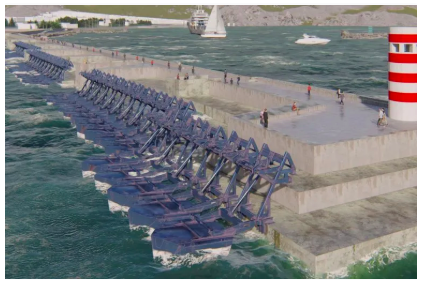 ecowavepower.com
What is Wave Energy?
This technology attempts to harvest energy from the movement of ocean waves in order to generate power for use by humans. As wind transfers its energy to the surface of oceans through friction, kinetic and potential energy is created from the water’s motion and its being lifted against gravity. Specialised technologies (wave energy converters, WEC) capture this energy and convert it to electricity for human use. Obviously, this technology is rather restricted to specific areas of the world with its prime location being the west coast of continents between 30° and 60° latitude where the strongest winds occur and create the most powerful waves.
There exist a variety of WECs: floating buoys that move up and down with the swelling of waves to drive an internal generator or hydraulic pump–known as point absorbers; reservoirs with walls located at sea level that get filled by wave action and then drain to turn a low-head turbine–known as overtopping devices; flaps or panels affixed to the seabed in shallow waters that get moved back-and-forth with the water action driving a generator–called oscillating wave surge converters; and a number of others.
The energy harvested from the world’s ocean waves is potentially enormous. The International Panel on Climate Change estimates that globally some 29,500 terawatt hours of energy could be provided to humanity (see this). Despite this potential, the harvesting of wave energy is still in its infancy with most projects in their prototype and testing phase.
The benefits of this type of potentially ‘clean and sustainable’ energy production are seductive. The power density is high, much denser than that provided by wind turbines or solar photovoltaic panels. Wave activity is predictable with activity being forecast relatively accurately days in advance aiding in grid management. And, the energy source can be provided almost constantly, day and night all year long.
Advocates highlight these benefits and argue it is one of the most promising future contributors to a ‘clean’ energy mix, especially for remote coastal and island communities who currently depend upon expensive diesel generators. It can also provide relatively consistent power generation to supplement more intermittent ‘renewables’.
High power density. Constant and predictable energy generation. And ‘clean and sustainable energy’. What’s not to love?
Well…

If you’re new to my writing, check out this overview.
There are a number of fundamental factors that challenge this technology before we even discuss the broader implications of chasing another technology to add to humanity’s seemingly insatiable energy consumption.
Costs
Current estimates of costs for wave energy generation are quite high relative to other technologies. The material challenges, complex manufacturing, and structural expenses all push up prices. Those marketing it argue that economies of scale will bring these costs down once the technological components are more widely produced.
Direct Environmental Impacts
The direct impacts on marine wildlife of this technology are quite concerning to some. They include: underwater noise; collisions and entanglement; electromagnetic fields; habitat change and loss; water quality impacts; and, altered hydrodynamics and sediment transport. The long-term consequences are not yet known but are in the process of being studied at current test sites.
Technical and Material Hurdles
The harsh marine environment presents a number of intractable issues: corrosion from saltwater; biofouling from organisms like barnacles; and extreme mechanical forces from storms.
These factors lead to metal fatigue, increasing drag, and monumental survivability challenges. Finding durable materials that can withstand these conditions at a reasonable cost is extremely difficult. Research continues on how best to address these issues but for the moment using high-strength steel coated with a specialised thermochemical layer provides some protection from corrosion and reduces organism attachment.
Withstanding significant storm waves is a must but very challenging to guarantee, especially at a reasonable cost. Concrete and/or steel structures offer protection for some designs. This particular ‘solution’ can increase costs dramatically, perhaps by 25-50%, and its negative environmental impacts are significant.
Research into novel materials with which to construct WECs and ensure suitable energy conversion continues. These include: rubber-like material that generates power when stretched–dielectric elastomers; Polyvinylidene Fluoride combined with graphene that will generate electricity when flexed by waves–piezoelectric composites; and, devices that generate power via friction between polymers–triboelectric nanogenerators. These are all rather expensive and require significant chemical and material-refinement industrial processes for their production.
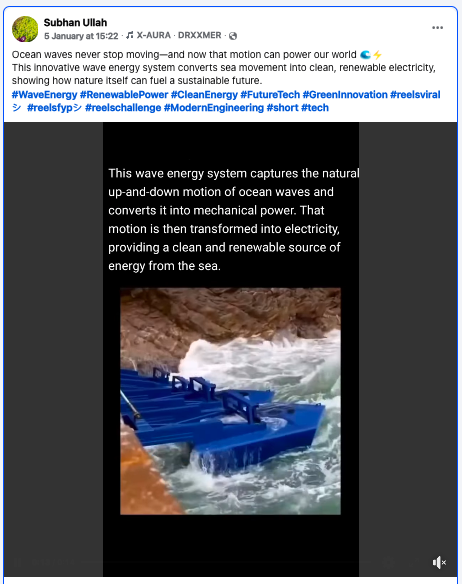 Typical click-bait site post regarding wave energy.
Clean, Sustainable. Powering Our World.
Commercial Viability
The monetary and resource costs for this technology are substantial, and one of the main reasons they are not commercially widespread. Massive steel and concrete structures upon which to attach many WECs are required for several types. Sea transportation and deployment is exorbitantly cost prohibitive. Advocates argue that they can be made far more reasonable in cost with economies of scale and continued research. Note the common refrain of many energy-technology cheerleaders: “We need more funding for research and once a massive build out is carried out, this latest ‘saviour’ will be cost competitive”–in other words, pay us now and you’ll reap the benefits some time down the road.
Even if all the above cost and engineering hurdles were to be overcome, the foundational flaws that plague proposed ‘clean’ technologies remain.
Common Energy Technology Issues of Concern
Claims of Being ‘Clean and Sustainable’
Once deployed and functioning, the claims regarding generation of ‘clean and sustainable’ energy are easy to make (as long as you can ignore the immediate environmental impacts). But prior to such deployment there are a host of industrial processes employed and resources required, especially hydrocarbons and various materials/minerals. Yes, the impacts are ‘mostly’ upfront, but they are there and quite substantial nonetheless.
And the ever-present narrow focus upon carbon emissions–due to carbon tunnel vision that seems to permeate all discussions and interpretations of ‘clean energy’–is problematic in its overlooking of ecological systems destruction beyond the narrow perspective this focus causes. Any mass-produced, industrial technology entails a destructive lifecycle: from extraction and refinement of materials, to manufacture and distribution, and finally to reclamation or disposal.
Even if lifecycle analyses of a technology demonstrates less carbon intensity than another, this does nothing to address the other ecological systems damage being carried out nor the issue about continuing to chase growth and complexities via complex industrial-based energy technologies. ‘Greening’ a supply chain or reducing the ‘footprint’ of such technologies serves more to create comforting narratives and rationalisations than addressing the fundamental predicament of ecological overshoot our species’ growth and activity has created.
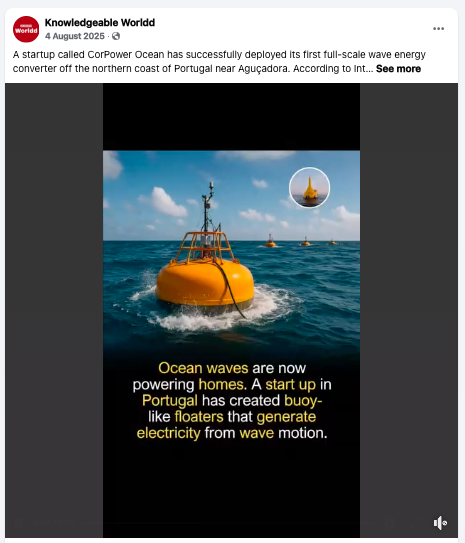 Another click-bait site post.
Powering our homes.
Replacement Theory
As with every other energy source, the power generation being created by WECs is adding to humanity’s energy consumption; it is not replacing the hydrocarbons that its proponents argue it is.
But even beyond this rather simplistic narrative about non-renewable, renewable energy-harvesting technologies replacing hydrocarbons, is the evidence that they are part and parcel of the problem. Every step in their supply chains and manufacturing requires hydrocarbon inputs. And this is especially so for WECs and their chemical coatings, concrete and steel structures, plastic and steel components, etc.. These are hydrocarbon-dependent technologies and are helping to draw down ever more quickly this finite material.
In addition (no pun intended here), these new energy technologies are fuelling the larger fire of humanity’s resource consumption. Hydrocarbon extraction continues to increase year-over-year, as does the energy use by our species. There appears to be no replacement taking place.
Technological Chickens Yet to Hatch
There are two fundamental issues that get glossed over during discussions about ‘renewables’ that get to the heart of notions regarding human society’s ‘sustainability’.
First, there exists ‘embodied hydrocarbons’ a plenty. All extraction and refining of material and minerals are only possible because of hydrocarbons. And virtually all large-scale industrial manufacturing is powered by and made from products reliant on hydrocarbons. And this is a finite energy source that has hit significant diminishing returns.
Second, the rebound effect and consumption growth that accompanies energy efficiencies or new energy sources. Known as Jevon’s Paradox, this phenomenon sees energy generation such as that from WECs added to the global total rather than displacing old sources; and helping to keep alive the comforting narratives that the perpetual growth chalice is within reach. Coal, for example, did not replace biomass as a heat source; the planet is seeing increasing amounts of biomass used for a variety of purposes. Oil did not replace coal as an energy source; we are seeing increasing amounts of coal mined every year. ‘Renewables’ are not replacing oil for energy generation; they are adding to our overall energy consumption.
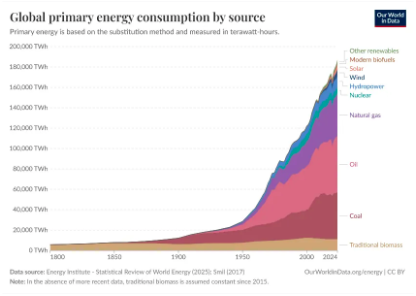 ourworldindata.org
More to the point, much of the argument for the technologies marketed as being ‘cleaner, sustainable, and capable of replacing hydrocarbons’ is based almost invariably upon as-yet-to-hatch technological chickens. If only more research funds are steered into them and/or funds are made available to build them out extensively, then the utopian dreams of ecomodernists and cornucopians will come to fruition. Any. Moment. Now. Just have faith. And placing human survival on technological breakthroughs that are always just over the horizon is a form of collective delusion.
Conclusion
Wave energy advocates present an attractive vision of dense, predictable, and constant ‘renewable’ power generation that’s ‘clean and sustainable’. Upon closer examination, however, such a promise is another in a rather long line of technologies that cannot possibly meet the hype. From corrosion and survivability to prohibitive costs and habitat disruption, there are serious material, economic, and environmental challenges to any near-term viability and possible scalability.
Perhaps more importantly this technology, like other ‘clean and sustainable’ ones, is constrained by two major systemic issues. First, it is an energy source being added to humanity’s seeming insatiable energy consumption and not a replacement for ‘dirtier’ energy sources as most such technologies are marketed as being. It is almost totally dependent upon hydrocarbon-intensive supply chains and production and thereby can never be a ‘replacement’.
Second, similar to all other ‘renewable’ technologies being hyped globally it helps to perpetuate a dangerous illusion that humanity can innovate its way clear of the consequences of ecological overshoot while maintaining perpetual economic and energy-demand growth. Wave energy is yet another distraction helping to create a comforting narrative about human progress while drawing down finite resources, destabilising ecological systems, and overloading planetary sinks.
The evidence appears to be clear: no technology can ‘save’ a global civilisation determined to pursue infinite growth on a finite planet. We’re telling ourselves comforting stories by believing in the tales of technological salvation and exacerbating our predicaments by acting upon them.
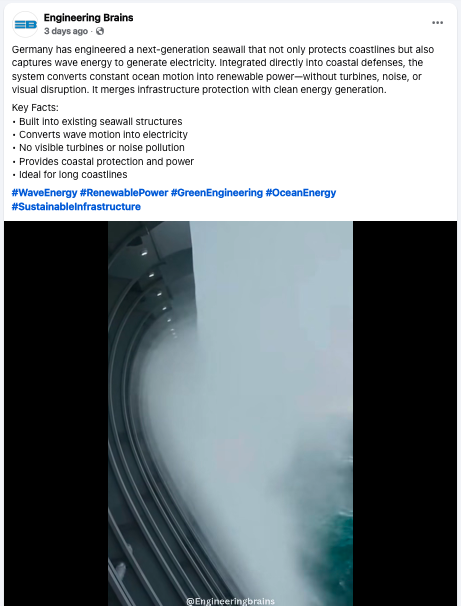 Another click-bait site post.
Constant. Renewable. Clean. Sustainable. Green.
Afterword
A bit of research revealed that the site of the original article that spurred this Contemplation described itself as an “internet destination for those who care about our planet and environment and want to make a difference…[and] for people who care about the Earth and have an interest in nature, the environment, and science. It’s for those who care about our planet and want to make a difference.”
The site had many, many articles on technological ‘solutions’ to our various predicaments but few on sociocultural shifts to address or mitigate our plight. For example, I found close to a dozen on wave energy and only a single one on degrowth; I found countless numbers on ‘clean energy’ technologies (from the best investment ventures to support research and where to mine the best lithium, to hydrogen- and fusion-based energy and how the renewable energy transition will boost the economy), and only four on permaculture. Pushing an ecomodernist/cornucopian ‘technology will save us’ narrative. Not very caring about the planet, environment, or Nature in my opinion.
We’re telling ourselves comforting stories–precisely the kind promoted by ‘caring’ planetary sites–by believing in tales of technological salvation, thereby exacerbating the very predicaments we seek to solve.
Recent and relevant articles:
Beyond The Mordor Economy – The Honest Sorcerer
Manifest Destiny: The Thermodynamic Hubris of the True Believer [EARLY ACCESS]
Nano Nuclear Enters The Asian Market | ZeroHedge
Nuclear Reactors On The Moon By 2030 | ZeroHedge
On Nature’s Complexity and Human Morality
Is the IEA Quietly Turning Bullish?
Data Centers Are Pushing Arizona’s Grid to a Breaking Point
Green Energy and the Oil Companies – by Ian Sutton
Energy and Wealth: The Correlation That Built Nations
Technology and Wealth: The Straw, the Siphon, and the Sieve
A Potential Solution to Climate Catastrophe
Why Civilisations Collapse: The Existential Paradox of Innovation
Systemic Stupidity Part III: The Physics of Scale
We’re Racing Down the Highway to a Mad Max World – ZNetwork
The Sustainability Conference Where Everyone was Given Truth Serum
Regenerating Earth Through Collapse | by Joe Brewer | Jan, 2026 | Medium
Energy, population, and production – by Jeff McFadden
What is going to be my standard WARNING/ADVICE going forward and that I have reiterated in various ways before this:
“Only time will tell how this all unfolds but there’s nothing wrong with preparing for the worst by ‘collapsing now to avoid the rush’ and pursuing self-sufficiency. By this I mean removing as many dependencies on the Matrix as is possible and making do, locally. And if one can do this without negative impacts upon our fragile ecosystems or do so while creating more resilient ecosystems, all the better. Building community (maybe even just household) resilience to as high a level as possible seems prudent given the uncertainties of an unpredictable future. There’s no guarantee it will ensure ‘recovery’ after a significant societal stressor/shock but it should increase the probability of it and that, perhaps, is all we can ‘hope’ for from its pursuit.”
If you have arrived here and get something out of my writing, please consider ordering the trilogy of my ‘fictional’ novel series, Olduvai (PDF files; only $9.99 Canadian), via my website or the link below — the ‘profits’ of which help me to keep my internet presence alive and first book available in print (and is available via various online retailers).
Attempting a new payment system as I am contemplating shutting down my site in the future (given the ever-increasing costs to keep it running).
If you are interested in purchasing any of the 3 books individually or the trilogy, please try the link below indicating which book(s) you are purchasing.
Costs (Canadian dollars): Book 1: $2.99; Book 2: $3.89; Book 3: $3.89
Trilogy: $9.99
Feel free to throw in a ‘tip’ on top of the base cost if you wish; perhaps by paying in U.S. dollars instead of Canadian. Every few cents/dollars helps… https://paypal.me/olduvaitrilogy?country.x=CA&locale.x=en_US
If you do not hear from me within 48 hours or you are having trouble with the system, please email me: olduvaitrilogy@gmail.com.
You can also find a variety of resources, particularly my summary notes for a handful of texts, especially William Catton’s Overshoot and Joseph Tainter’s Collapse of Complex Societies: see here.