Today’s Contemplation: Collapse Cometh CCLIV–Affordability, Collapse, and the Architecture of Hydrocarbon Decline, Part 1
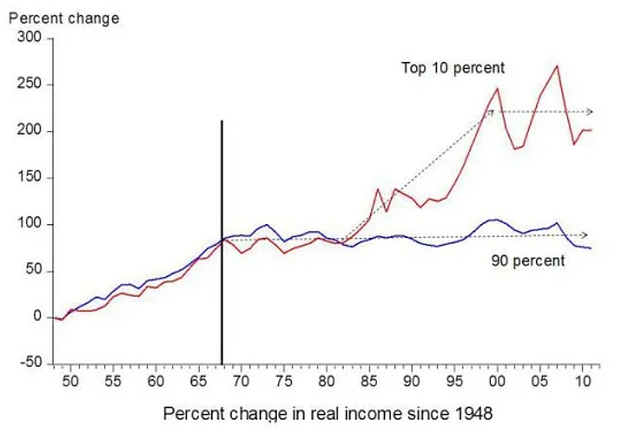
US Changes in Real Income
Affordability, Collapse, and the Architecture of Hydrocarbon Decline
On the heels of my two-part Contemplation that took a look at the supply-side dynamics of hydrocarbons–particularly oil–and the consequences of the geologic reality for our global, industrial civilisation (see: Part 1 Website Medium Substack; Part 2 Website Medium Substack), Gail Tverberg, who writes at Our Finite World, published an article entitled Affordability, Not Scarcity, Is the Real Energy Crisis. In it, she argues that the world faces not a physical scarcity energy crisis but an affordability one: rising energy costs cannot be afforded by an increasing number of consumers. Looking at energy consumption from 1820 to the present, Gail identifies three “Troubled Periods” when low energy consumption happens to coincide with economic crashes, war, and government collapses.
Gail’s thesis is relatively straightforward and I believe complements my own analysis. She argues that during high-hydrocarbon demand timeframes (e.g., 1950s-1970s) growth in energy consumption took place alongside rising living standards and economic expansion. But during low-demand periods, such as we are now experiencing, consumption contracts significantly and especially for the bottom 90% of income earners whose wages have mostly stagnated for the past 50 years; almost all financial gains over this time have been experienced by the top 10% of earners.
When energy growth is high, societies witness rising living standards; but when it is low or turns negative, “troubled” times occur. Using historical data, Gail identifies three such “Troubled Periods”: 1857–1865, when the 1857 Economic Panic occurred and the US experienced its Civil War; 1920–1940, which witnessed the Great Depression and World War Two; and 1990–2000, which coincided with the Soviet Union’s collapse and the Asian Financial Crisis.
She describes economies as self-organising dissipative structures that require energy for their functioning. When energy is insufficient to support such structures, they are prone to collapse. The current period of “trouble” is experiencing such insufficient energy and is likely to witness falling asset prices (e.g., shelter, land), the collapse of various debt bubbles (e.g., commercial real estate, AI), a major recession, and even the collapse of some governments. Finally, Gail suggests that because economies tend to show self-healing properties, it is likely that further down the road we may see new governments and businesses that are more efficient and less energy-intensive arise from the wreckage.
This is a timely analysis with respect to my supply-side constraint argument that focussed upon depletion geology, falling energy return on investment (EROI), and at-scale hydrocarbon irreplaceability. Equally constraining, perhaps more so for immediate concerns regarding our predicament, is Gail’s look at the demand-side dynamics at play.
For Gail, the crisis is one of affordability and not that we are running out of oil; this is a counterintuitive argument that warrants careful consideration. And I would argue that this is not a refutation of my analysis but is complementary in that it highlights a mechanism that I referenced but did not explore fully: the relationship between economic growth, energy surplus, and the financial superstructures that are constructed atop them.
I don’t believe that the collapse I am discussing here can be explained by either of these mechanisms alone, but rather that they are mutually reinforcing. The affordability issue that Gail discusses would still undercut demand if incomes fell but EROI were to remain stable. And, if incomes rose but EROI collapsed, it is likely that extraction costs would eventually outstrip prices. As I describe below, it is their interaction that creates a feedback loop.
The Affordability Bottleneck
Gail points out something that many of the ruling class and their bureaucrats refuse to look at and acknowledge: about 90% of income earners have been experiencing stagnating income for some 50 years. This places a significant constraint upon demand for energy, since continued extraction depends greatly upon the middle and working classes being able to afford to consume the products created by energy and material throughput. Without such demand, there exists little incentive to pursue continuing extraction. As great as the demand by the top 10% can be, the loss of billions of consumers on the planet–especially those in “advanced” and emerging economies–has a significant impact. This creates a vicious cycle that Gail frames as one of affordability, but I describe in terms of EROI.
I would argue that there exists an alignment between Gail’s and my perspective, and one that shows a troubling logic. More energy must be invested into energy extraction processes when they are experiencing falling EROI if the surplus energy required to support societal complexities–especially the broader economy–is to be maintained; let alone grow. Higher prices for energy (and thus everything) accompany higher costs for its extraction, and most consumers (the 90% experiencing stagnating incomes) are having difficulty absorbing such increases.
When the economy contracts due to reduced consumption, energy demand falls, leading to lower energy prices, which in turn make marginal extraction less profitable (or even unprofitable at times) and eventually impact supply. This occurs when demand destruction pushes spot prices below the marginal cost of new or high-cost extraction–that is, if the price of energy falls low enough and curtails new investment, supply decline is accelerated. It’s not unusual for an extraction industry experiencing falling profits to pull back on its production of energy; and this, I would argue, may be the fundamental predicament of Peak Oil.
I don’t see the affordability issue Gail discusses as being separate from the supply one I discuss; I see it as a manifestation of the geological constraints. When the surplus that supports non-extractive activities begins to fall, the economic superstructure that’s built upon it begins to experience problems. And Gail highlights that this pattern has played out several times since about 1820.
The Three “Troubled Periods” and Their Lessons
Using the historical record to ground her theoretical framework, Gail identifies three periods she terms “Troubled”, which are characterised by: low to negative energy consumption growth per capita; debt crises and/or financial crashes; major geopolitical realignments, including war; and political system collapse.
Of particular note for an analysis focussed upon hydrocarbons is the second period Gail identifies (1920–1940). This “Second Troubled Period” is linked to Peak Coal, which occurred first in the United Kingdom close to the time of World War 1, and then in Germany during the time of World War 2.
Gail’s assertion that war could be understood as an attempt to deal with energy constraints due to depletion deserves some further scrutiny, for it reflects my argument regarding the Maximum Power Principle (which she also mentions) and the tendency of societies to pursue increased energy throughput via conflict rather than accept simplification when energy returns on investment are declining. Geopolitical conflict, it would seem, is very often driven by the pursuit of resources, and Gail suggests that this is fundamentally a thermodynamic feature and not simply political: a system facing energy scarcity will often, if not always, compete over resources. This competition will also often be destructive in nature.
Soviet Union Collapse as a Template
We may get a glimpse of what lies ahead for our modern societies by better understanding Gail’s analysis of the “Third Troubled Period”, which includes the collapse of the Soviet Union. Like all complex societies, the Soviet Union was dependent upon a growing energy surplus to help support its various institutions, social contract with its people, and military. Due partially to a sudden spike in interest rates (1980–81), oil prices fell while the cost of extraction from declining fields rose. Government commitments by the Soviet political class became unaffordable, leading eventually to the entire system unravelling.
With factories closing, transportation networks contracting, and falling standards of living across the various nations that composed the union, there was a precipitous decline in energy demand. While some regions fared better and some far worse, societal simplification was the general path across the Soviet Union.
My Peak Oil Contemplations describe such a scenario, where a cascade of interacting failures tends to amplify one another over time rather than taking place as a cataclysmic single event of collapse. Financial institution strain or failures reduce energy infrastructure investments, leading to a reduction in energy availability and economic activity. This economic contraction results in tax revenues falling for governments and the eventual undermining of the services they provide. Such erosion further undermines the economy. Each failure in this chain feeds into the others and amplifies them.
The Limits of “Self-Healing”
Gail notes that economies tend to be self-healing in that over the longer term, new governments and businesses will emerge from the ashes of the failed ones. She also contends that these will tend to be more efficient and less energy-intensive than those that came before them. On a somewhat similar note, I’ve pointed out that the historical evidence shows that societal collapse has not been an extinction-level event for our species or even impacted societies, but a simplification with populations dispersing into surrounding regions to begin anew.
We must not be overly optimistic about such healing this time around; in fact, Gail herself notes that such a rebirth may take many years, even if possible. If the energy systems our societies depend upon remain intact–a questionable assumption–such healing can occur within a decade or two. But what if, as I have argued, the foundational system that supports our many intertwined global complexities is in terminal decline? When I speak of “terminal decline” I am referring to the EROI falling below the minimum surplus necessary to maintain economic and societal complexity–a point where reversal becomes exceedingly unlikely due to a fall in the amount of surplus required to build new and efficient infrastructure. Things become far more uncertain in such a scenario.
The Soviet Union’s collapse was a mostly regional affair but occurred within a broader global economy that was well supplied with hydrocarbons, so its crisis did not spread significantly beyond its borders; any perturbations from the Soviet collapse that were felt elsewhere were dealt with in relatively short order. Today’s world, however, has few, if any, regions that could serve as an engine of recovery for a crisis that is global in nature.
Regions and sectors are unlikely to experience collapse at the same time; rather, history shows that collapse proceeds piecemeal across societies, with some local systems surviving or adapting. However, the absence of a resilient and well-supplied haven that could help to reboot a broad recovery makes such a scenario unlikely. The peak of easy-to-access and cheap-to-retrieve conventional, high-EROI oil is well in the rear-view mirror, with unconventional sources–that are experiencing declining EROI and approaching their own peaks–now dominating production. The global economy has no safe haven upon which to look for salvation.
Affordability as a Precipitating Factor
Gail’s article focuses upon a factor that I underemphasised: affordability. The decline in EROI makes collapse of hydrocarbon extraction inevitable, but the affordability aspect may be the mechanism that precipitates it.
A disturbing but logical chain of events would seem to follow from this affordability crisis. EROI decline is a facet of the extraction of any finite resource, and all hydrocarbon sources experience it. Such decline results in a loss of surplus energy, the support for economic complexity and activity. As the lowest-hanging fruit with the highest EROI encounters depletion, the price for energy, and thus extraction, is pressured higher. As surplus energy declines in availability, income stagnates for the bottom 90% of earners at the same time that wealth becomes more concentrated among the top 10%. As energy becomes unaffordable for most, demand for it falls, which leads to less profitable extraction. As this occurs, investment in future extraction drops, causing the decline in physical supply to accelerate.
This thought-experiment scenario assumes that demand is falling quicker than supply, or that any price increases that might help revive investment are both high enough to stimulate new investment and low enough to be absorbed by the broader consumer base. If, however, sharp and sudden supply shortages create price spikes, there may be some temporary marginal production performed but this could crush affordability leading to even more serious demand destruction. The ultimate outcome remains the same with only the severity and timing differing.
Parallel to all this is a growing economic contraction that causes government tax revenues to fall and results in less service for citizens, falling maintenance of societal complexities such as infrastructure, increased borrowing and money printing by governments and businesses, leading to a growing loss of purchasing power for consumers, which results in a further decline in demand. All of this is not only a vicious cycle that feeds upon itself but is characteristic of Tainter’s thesis regarding declining marginal returns on investments resulting in the unravelling of complexity–in other words, simplification.
Gail’s affordability thesis is not, then, an alternative explanation to the peak oil thesis I lay out, but a complement to it. The conditions for unaffordability are created by the supply constraints, and as this unaffordability speeds up, the decline in supply accelerates; a supply crunch that physical depletion makes inevitable. These processes are mutually reinforcing and not contrary.
This concludes Part 1 of this Contemplation. In Part 2, I will examine what all of the above means for the Architecture of Collapse thesis I have been developing. I will argue that Gail Tverberg’s proposal regarding energy affordability reinforces my argument that collapse of industrial civilisation is likely to be characterised by a cascade of interacting and self-reinforcing failures. I will then examine this in the light of the arguments made by Joseph Tainter regarding diminishing returns and investments in complexity, and Ronald Wright on progress traps and the tendency for solutions to create further problems. Tainter’s thesis reflects well the rising extraction costs as EROI declines, and Wright’s traps the knock-on impacts of short-term “solutions” that increase supply temporarily but speed up its depletion and deepen the crisis–such as deep-water drilling and hydraulic fracturing. I close with a reflection on what this suggests for the future of our large, global, and exceedingly complex industrial civilisation.
Special Offer
If you have made it to the end of this Contemplation, I have an offer for you. Send me an email at olduvaitrilogy@gmail.com requesting a copy of Part 1 of my trilogy and I’ll fire off a PDF of it to you for your “fictional” reading pleasure. If you like the beginning of the tale, please consider ordering the trilogy here: Purchase Book(s) — Olduvai.ca.
What is going to be my standard WARNING/ADVICE going forward and that I have reiterated in various ways before this:
Only time will tell how this all unfolds but there’s nothing wrong with preparing for the worst by ‘collapsing now to avoid the rush’ and pursuing self-sufficiency. By this I mean removing as many dependencies on the Matrix as is possible and making do, locally. And if one can do this without negative impacts upon our fragile ecosystems or do so while creating more resilient ecosystems, all the better.
Building community (maybe even just household) resilience to as high a level as possible seems prudent given the uncertainties of an unpredictable future. There’s no guarantee it will ensure ‘recovery’ after a significant societal stressor/shock but it should increase the probability of it and that, perhaps, is all we can ‘hope’ for from its pursuit.
If you have arrived here and get something out of my writing, please consider ordering the trilogy of my “fictional” novel series, Olduvai (PDF files; only $9.99 Canadian), via my website or the link below — the “profits” of which help me to keep my internet presence alive and first book available in print (and is available via various online retailers).
Attempting a new payment system as I am contemplating shutting down my site in the future (given the ever-increasing costs to keep it running).
If you are interested in purchasing any of the 3 books individually or the trilogy, please try the link below indicating which book(s) you are purchasing.
Costs (Canadian dollars):
Book 1: $2.99
Book 2: $3.89
Book 3: $3.89
Trilogy: $9.99
Feel free to throw in a “tip” on top of the base cost if you wish; perhaps by paying in U.S. dollars instead of Canadian. Every few cents/dollars helps…
https://paypal.me/olduvaitrilogy?country.x=CA&locale.x=en_US
If you do not hear from me within 48 hours or you are having trouble with the system, please email me: olduvaitrilogy@gmail.com.
You can also find a variety of resources, particularly my summary notes for a handful of texts, especially William Catton’s Overshoot and Joseph Tainter’s Collapse of Complex Societies: see here.